|
Mazano Hub Accountability Is the Hidden AdvantageThe founders who build lasting businesses don't just have ideas — they have systems that keep them moving. Week of May 29, 2026 | Mazano Hub Weekly |
||
|
Every week, thousands of African entrepreneurs write business plans, set goals, and commit to launching something new. Most of those plans are never executed. Not because the founders lacked talent, capital, or market opportunity — but because they had no one holding them to their word.
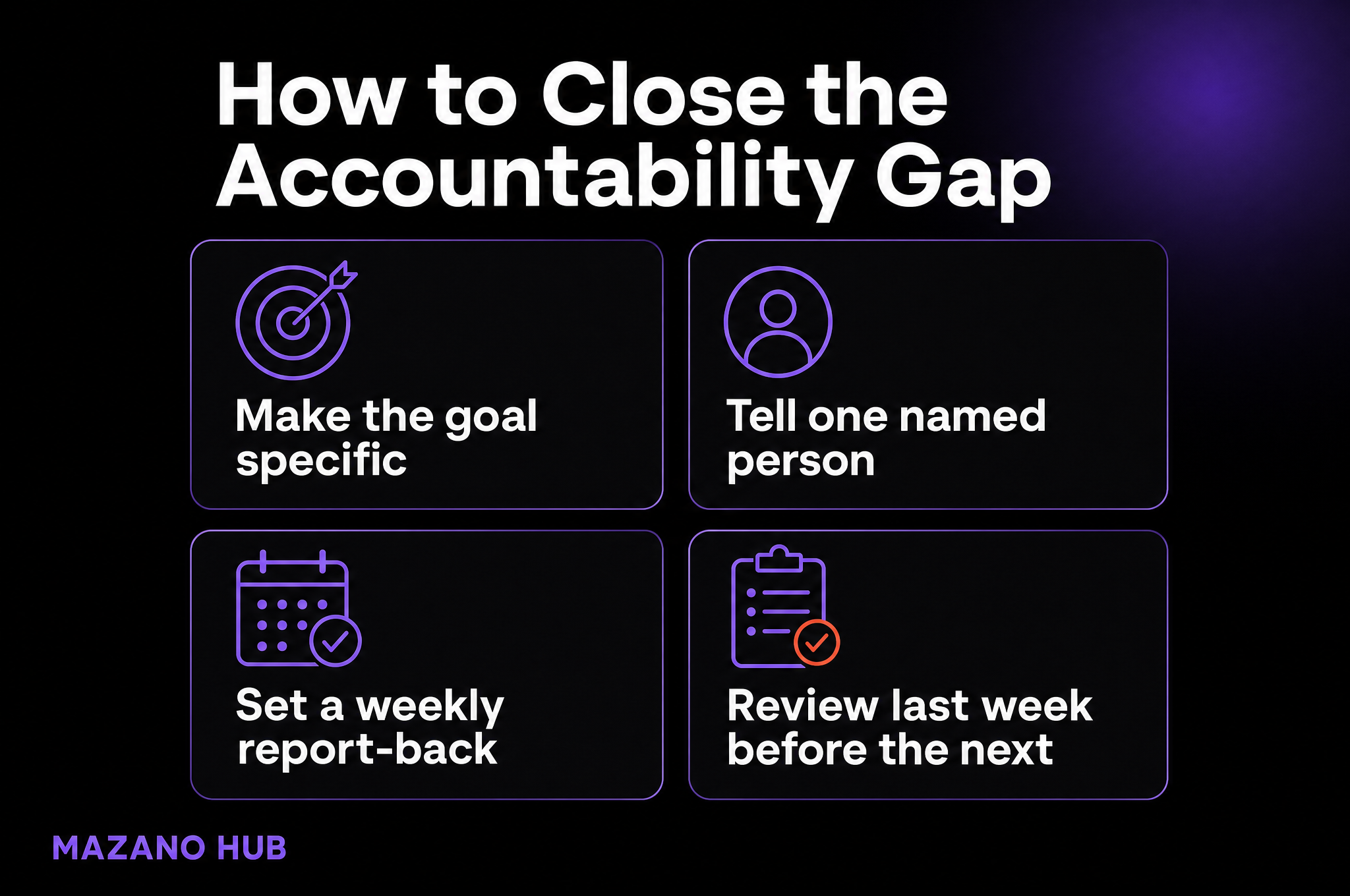
Accountability is unglamorous. It does not make headlines the way fundraising announcements do. But in early-stage entrepreneurship — especially in high-pressure markets like Zimbabwe — accountability is frequently the difference between a founder who ships and one who stalls. The Accountability Gap: Why Good Ideas StallThe accountability gap is the distance between intention and action. In isolated working environments — home offices, informal market stalls, freelance arrangements — founders have no external structure to generate urgency. Deadlines are self-imposed. Progress reviews are skipped. Goals drift. Research consistently shows that sharing a goal with a specific person — and committing to report back — raises the probability of completing that goal by more than 65 percent. This is not a personality trait of disciplined founders. It is a structural condition. When the structure is in place, execution follows. When it is absent, even capable founders underperform. In Zimbabwe, the structural challenge is compounded by environment. Electricity instability, economic volatility, and access constraints mean founders already carry an unusually heavy cognitive load. Adding self-accountability management on top of that load is often one task too many. This is not weakness. It is math. The founders who succeed long-term are almost never the ones who "white-knuckled" their way through in isolation — they are the ones who found or built an external accountability system early. What Real Accountability Looks Like for African FoundersReal accountability is not nagging. It is not check-ins that feel like surveillance. For African founders, the most effective accountability structures share three qualities: they are specific, relational, and rhythm-based. Specific: Vague commitments ("I'll work on the business this week") produce vague results. Effective accountability requires naming the exact deliverable — a prototype tested, a pricing model completed, five customer calls made. When the commitment is concrete, both the founder and the accountability partner can clearly see whether it happened. Relational: Accountability works when the relationship carries weight. A mentor whose opinion the founder respects. A peer cohort that the founder does not want to let down. A community that has invested time and trust. Accountability to a stranger or an app rarely sticks; accountability to someone who knows your story carries real social consequence. Rhythm-based: Accountability is not a one-time event. It is a weekly or biweekly cadence — a standing check-in that creates a predictable moment of reckoning. Founders who know they will report progress on Friday build their weeks differently than founders who have no such marker. The rhythm, over months, becomes a business operating system. The Peer Effect: Why Community Outperforms Solo EffortOne of the clearest lessons from global incubator data is that peer cohorts consistently outperform solo founder programs. When founders go through a structured process together — sharing milestones, reporting to each other, celebrating wins and naming failures in community — they build businesses faster and with more durability than founders working alone, even when solo founders receive equal amounts of mentorship and capital access. The peer effect is partly accountability, but it is also something deeper: shared identity. When a founder is part of a cohort of people who are also building, they begin to see themselves as a builder rather than someone who is "trying to start a business." That identity shift matters more than most tactical interventions. It changes how founders introduce themselves, how they spend their evenings, and how quickly they recover from setbacks. In Zimbabwe specifically, peer accountability carries an added dimension: community is already a core cultural value. Ubuntu — the principle that "I am because we are" — is not just philosophy; it is a lived daily practice. When incubators structure accountability in ways that resonate with existing community frameworks rather than importing Western individual-achievement models, uptake and retention are dramatically higher. The accountability structure should feel native, not imported.
How Mazano Builds Accountability Into Every Cohort WeekMazano Cohort 1 is structured from the ground up around accountability as method, not add-on. Every week of the 90-day program includes a milestone commitment made publicly within the cohort — and a structured review of the prior week's commitment. Founders do not simply attend workshops and absorb information; they commit to applying it, report back, and adjust based on what worked and what did not. Each Cohort 1 founder is matched with a dedicated mentor — an experienced entrepreneur or professional with relevant domain knowledge — who provides a biweekly one-on-one check-in. These are not general advice sessions. They are progress reviews: what did you commit to, what did you ship, what is blocking you, and what is next. Mentors are selected in part for their willingness to hold founders to their word with warmth, not judgment. The peer dimension is equally deliberate. Cohort 1 is structured as a small group — intimate enough that every founder's progress is visible to the group. Founders know each other's businesses, celebrate each other's milestones, and name each other's blind spots. This is the kind of accountability that scales beyond the 90-day program: most Mazano cohort members describe staying in regular contact with their peers well after graduation. The faith dimension of Mazano's model reinforces this further. Accountability rooted in shared values — including the conviction that work is a form of service and that stewardship matters — creates a layer of motivation that purely commercial frameworks miss. Founders who understand their business as an expression of their purpose do not just want to succeed for themselves. They want to show up for their community, their family, and their faith. That is accountability that does not require an external enforcer. |
||
|
||
|
||
|
|
||
|
You are receiving this because you subscribed to Mazano Hub. © 2026 Mazano. Harare, Zimbabwe. |