|
||
|
MAY 22, 2026 | MAZANO.ORG | COHORT 1 — LAUNCHING MID-2026 |
||
|
Most early-stage entrepreneurs in Zimbabwe and across Africa have at least one thing in common: they charge too little. Not because they don't know their costs, but because they're afraid. Afraid of losing customers. Afraid of seeming greedy. Afraid the market can't afford more.
That fear is costing them their businesses. Chronic underpricing is one of the most pervasive and least discussed causes of African SME failure. It looks like humility. It feels like strategy. But it creates the same outcome every time: insufficient margins, no runway for reinvestment, and a business that works hard for years without ever building real wealth. This week's Mazano Hub article is a direct challenge to that pattern — with practical tools to break out of it. |
||
|
|
||
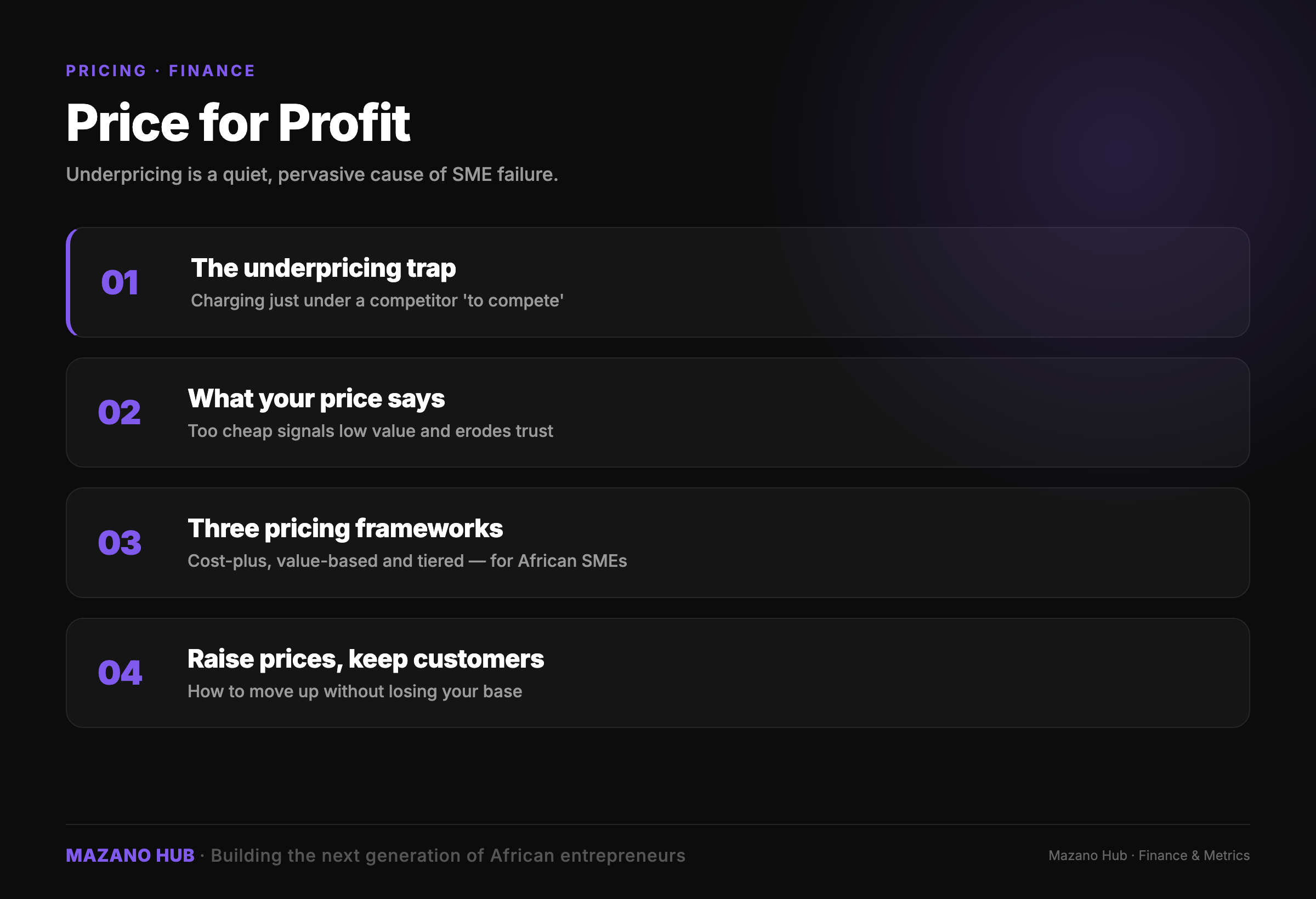
The Underpricing Trap Most Founders Fall IntoThe underpricing trap typically starts before the business does. A founder does a rough market scan, sees what a neighbour or informal competitor charges, and sets their own price slightly lower to "be competitive." It feels rational. In practice, it establishes a financial ceiling the business may never escape. The trap compounds because low prices attract the most price-sensitive customers — the ones most likely to leave the moment someone undercuts you further, and the least likely to refer premium buyers. The business gets busy, the founder works long hours, and at the end of each month there is not enough left to pay a fair wage to themselves, let alone save or reinvest. Research from across Sub-Saharan Africa consistently shows that informal and early-stage SMEs price at or near cost — sometimes below cost when indirect expenses like transport, mobile data, and time are excluded from the calculation. A 2024 IFC survey of 1,200 SMEs in East and Southern Africa found that 61% had never formally calculated their full cost of goods sold. They were guessing. And the guess was always low. The first step out of the trap is honesty: add every cost, including your time, and look at what number makes the business genuinely sustainable. That number is almost always higher than what you're currently charging. |
||
|
|
||
What Your Price Communicates to CustomersPrice is not just a number. It is a signal. Before a customer uses your product or tastes your food or experiences your service, they form a judgment based on what you charge. That judgment is sticky. It shapes whether they recommend you, what kind of customers they bring with them, and how much friction they accept if something goes wrong. In markets where formal quality certification is absent — which describes most of the markets Mazano entrepreneurs operate in — price becomes a proxy for quality and reliability. A tailor who charges $5 for a shirt signals something different to the buyer than one who charges $25, even if the fabric and workmanship are identical. The lower price may actually be generating mistrust, not winning customers. This is sometimes called the "price-quality heuristic" — and it is well-documented in consumer psychology across income levels and geographies. It applies in Harare, in Bulawayo, in Lagos, and in Nairobi. Buyers infer what they cannot inspect. This does not mean price high and hope. It means price at the level that reflects the real quality you deliver, then build the confidence to explain that value. Many founders discover that raising prices — paired with a clearer explanation of what customers receive — actually increases conversion, because it repositions them in the buyer's mind from "cheap option" to "the right choice." |
||
|
|
||
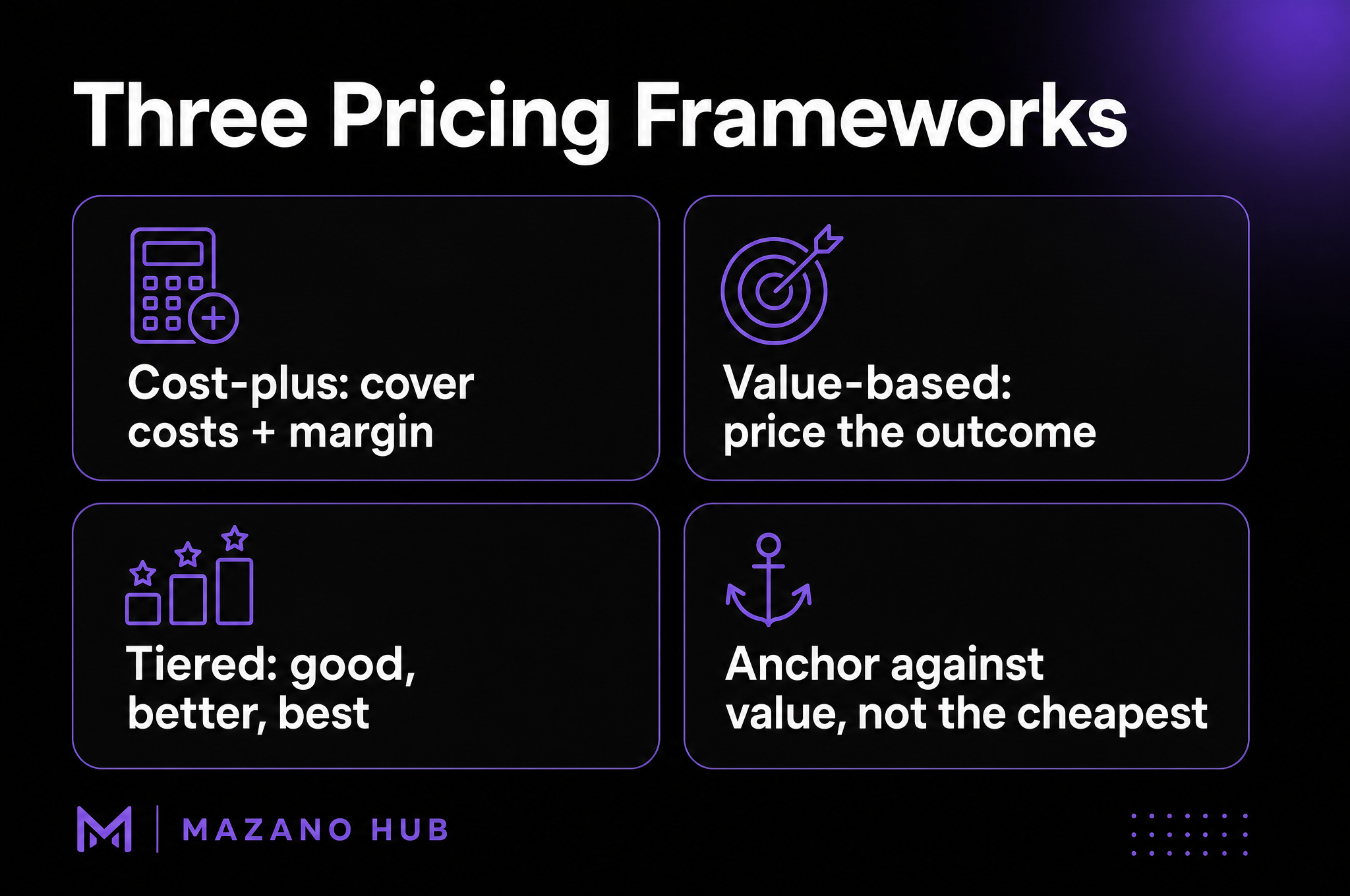
Three Pricing Frameworks That Work for African SMEsThere is no universal formula, but three frameworks consistently produce better outcomes than intuitive pricing for early-stage founders in Southern and East Africa. 1. Cost-Plus With a Real Profit Margin Start with every cost — materials, labour (including your own time at a fair hourly rate), overheads, and a buffer for waste and delays. Add a minimum 30% profit margin, not as a bonus, but as the reinvestment fuel the business needs to grow. If the resulting number seems high, investigate whether your costs are accurate before assuming the market won't pay. 2. Value-Based Pricing Instead of starting from costs, ask: what is the outcome worth to the customer? A bookkeeper who saves a business owner 10 hours per month provides quantifiable value. A seamstress who makes wedding attire is contributing to a once-in-a-lifetime event. Price anchored to customer outcome rather than input cost is almost always higher — and more defensible. 3. Tiered Pricing Offer three tiers: a basic option, a standard option, and a premium option. Research consistently shows that most buyers choose the middle tier, which should be the version you actually want to sell. Tiering serves two functions: it lets price-sensitive customers access your services at a lower level, and it establishes a premium anchor that makes your standard price feel reasonable. |
||
|
|
||
Raising Your Prices Without Losing CustomersOnce a founder decides to raise prices, the question becomes: how? The fear of losing existing customers is real, and it requires a deliberate approach rather than just updating a menu or invoice and hoping no one notices. The most important step is communication. Customers who are not told why prices are increasing will assume you are taking advantage of them. Customers who are told — clearly, respectfully, and with a reason anchored in quality or costs — typically accept increases far more readily than founders expect. A simple message acknowledging the change, thanking loyal customers, and explaining the reason (improved materials, more time invested, rising input costs) retains the relationship.
Practical tactics that reduce churn during a price increase: give existing customers a 30-day notice period; offer a transition option at the old rate for a final order; bundle in a small additional benefit that reinforces the new price's value. None of these are concessions — they are relationship investments. Finally, accept that some customers will leave. A founder who raises their catering service from $8 per head to $12 per head and loses three budget clients may find that the remaining clients more than compensate in margin and referral quality. Loss aversion is powerful, but the math usually works in favour of the price increase. The goal is not to charge whatever you want. The goal is to charge what your business actually needs to thrive — and then build the conviction to hold that price. |
||
|
||
|
Get Involved Help us build Zimbabwe's next generation of profitable founders.Mazano Cohort 1 launches mid-2026. Every dollar donated funds the coaching, resources, and accountability structures that help early-stage entrepreneurs build businesses that last — not just survive.
|
||
|
You are receiving this because you subscribed to Mazano Hub. | Unsubscribe Mazano | mazano.org | Zimbabwe & Global Diaspora |