|
Walk into any informal market in Harare, Nairobi, or Lagos and you will find something that would puzzle a Western venture capitalist: entrepreneurs who have been operating for years without a bank loan, a pitch deck, or an investor term sheet. They have customers. They have suppliers. They have people who show up at 6 a.m. and stay past 7 p.m. because they believe in what they are building.
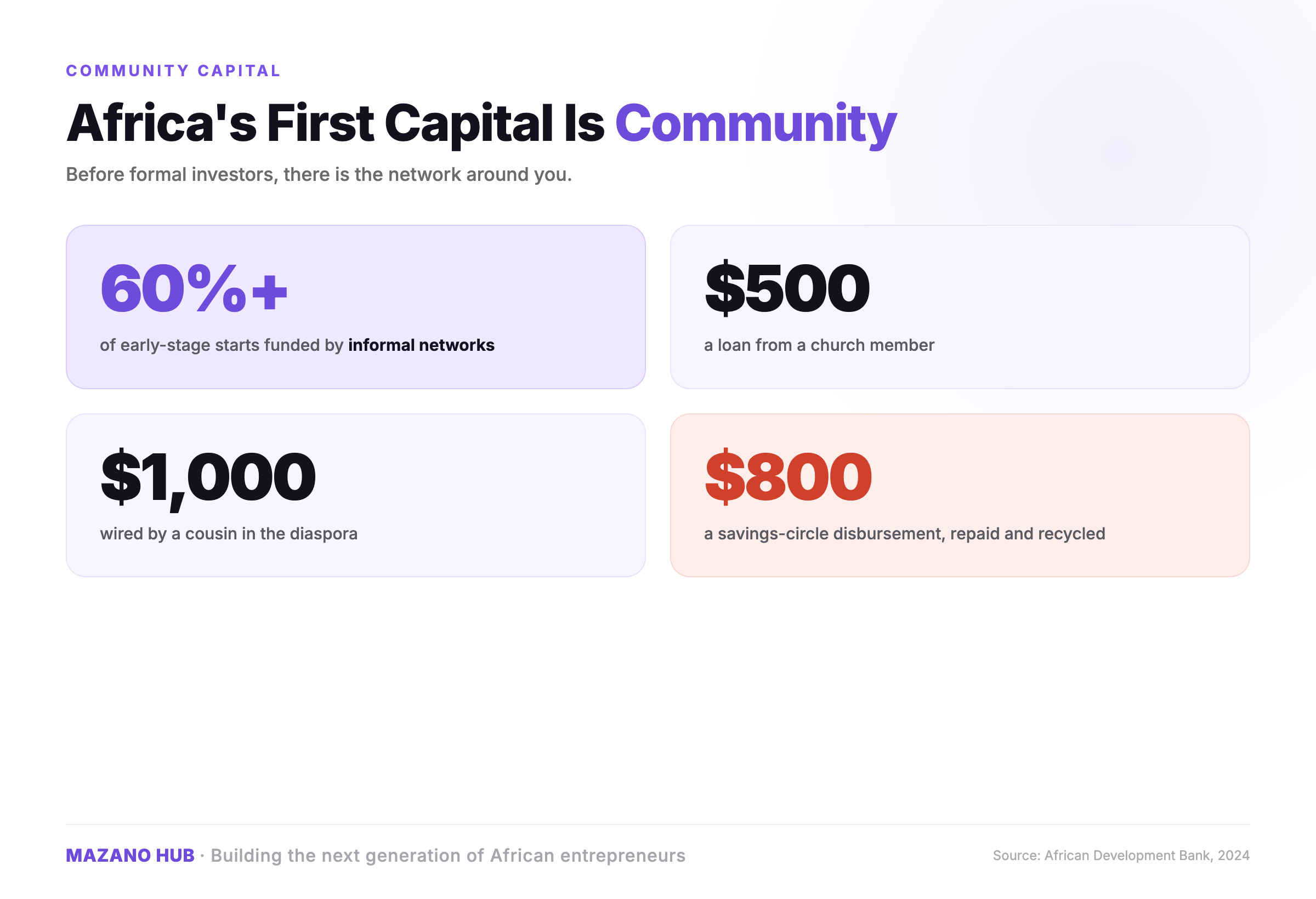
Ask these founders where they got their starting capital. The answer comes quickly: a church member who lent $500. A cousin in the diaspora who wired $1,000. A savings circle — a mukando — that pooled enough to buy the first inventory. A pastor who introduced them to their first wholesale supplier.
This is not a gap in the formal system. This is a parallel system — one that has been funding African entrepreneurship for generations, and one that formal institutions are only beginning to understand. At Mazano Hub, we believe the opportunity is not to replace these community networks. It is to build on them, strengthen them, and give the entrepreneurs inside them the structured support they need to grow.
|
|
Why Community Capital Works Before Formal Capital
Formal capital — bank credit, venture investment, institutional microfinance — requires documentation that most early-stage African founders do not yet have. A credit history. Audited accounts. Collateral. A registered business entity. These requirements are not arbitrary; they are how formal institutions manage risk. But they systematically exclude the earliest-stage founders, who are often the ones with the most hunger and the most community embeddedness.
Community capital works differently. It underwrites risk through relationships. When a church elder vouches for a young entrepreneur, he is substituting his social capital for the financial collateral the bank requires. When a savings circle disbursed $800 to a member last month and she paid it back, the next disbursement comes with a lighter burden of proof. Trust, built over years of shared worship, shared neighborhoods, and shared struggle, does what a credit score cannot: it accurately predicts character.
The data backs this intuition. A 2024 African Development Bank study found that informal lending networks fund more than 60% of early-stage business starts in Sub-Saharan Africa. In Zimbabwe, where bank lending rates have historically exceeded 50% annually and formal credit remains largely inaccessible to small operators, community networks are not an option of last resort — they are the first resort and, often, the only viable one.
Community capital also carries something formal capital rarely does: accountability structures that align with the entrepreneur's values. Borrowing from a church community means reporting back to that community. It means honoring a commitment made in a context where honesty and stewardship are not just virtues but expectations. That accountability makes repayment more likely and growth more sustainable.
|
|
The Diaspora-to-Founder Pipeline
Africa's diaspora sends home roughly $100 billion in remittances every year. That figure consistently exceeds foreign direct investment and official development assistance combined. Much of it goes to household expenses — school fees, medical bills, food. But a meaningful and growing share goes to something else: business starts and early-stage capital for relatives and community members building something.
The diaspora-to-founder pipeline is real, and it is more sophisticated than a wire transfer. Diaspora professionals in the UK, USA, Canada, and Australia are increasingly structured in their giving. They form WhatsApp investment groups. They run hometown associations that fund specific projects. They identify a promising founder back home — often a sibling, a church friend, a schoolmate — and make a calculated bet: $2,000 for inventory, $3,000 for a generator, $5,000 to formalize a supplier contract.
What these informal investors lack is structure. They are operating on gut, loyalty, and hope. They have no framework for evaluating business models, no milestone system for disbursing capital, and no way to support the founder beyond the money. The result is too often predictable: good intentions, poor execution, a strained relationship, and a business that doesn't reach its potential.
The intervention the diaspora-to-founder pipeline needs is not more money. It is structure. It is the same structure that angel investors in Silicon Valley apply — stage-gated capital, milestone accountability, mentorship alongside money — adapted for the African context and delivered through the community relationships that already exist. That is precisely what a well-designed incubator can provide.
|
|
Churches as Entrepreneurship Accelerators
The most underutilized business infrastructure in Africa is the church. This is not an overstatement. In Zimbabwe, church attendance runs above 85% of the population. Churches are the largest weekly gathering of working-age adults in most communities. They are trusted institutions with physical facilities, established governance structures, and deep social networks that cross economic classes, industries, and generations.
Churches already do the foundational work of entrepreneurship without calling it that. They build character. They cultivate accountability. They form community savings groups. They run cooperative buying clubs. They host skills training. They broker introductions. The accountant in the congregation becomes the young founder's first bookkeeper. The retired logistics manager becomes a mentor. The businesswoman on the deacons' board becomes the first customer and the most credible reference.
Across Africa, a new generation of churches is making this role explicit. Pastors are launching entrepreneur fellowship groups within their congregations. They are hosting pitch nights. They are forming church investment clubs where members pool funds to support vetted businesses. Peniel Church in Harare, Daystar Christian Centre in Nairobi, and Winners Chapel across West Africa are examples of faith communities that actively cultivate entrepreneurship as a Kingdom mandate — not separate from spiritual life but integrated into it.
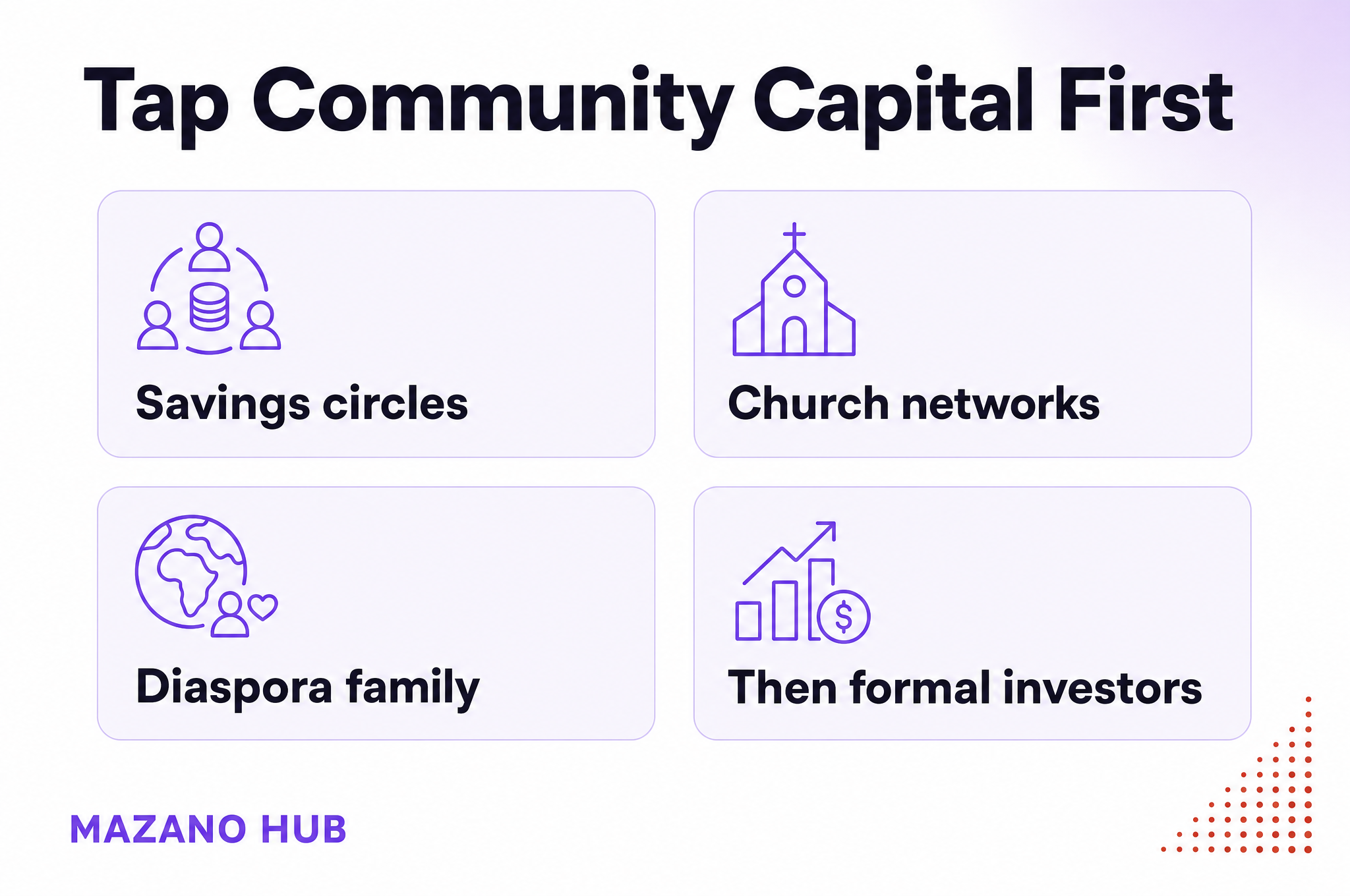 Tap Community Capital First |
The theological grounding matters here. Stewardship — the responsible use of resources entrusted to you — is a core biblical concept. When a church community frames entrepreneurship as stewardship, it changes the founder's relationship to the work. Profit is not just personal gain; it is the evidence of faithful management. Employment is not just a byproduct; it is a ministry. This framework produces founders who think long-term, treat their teams with dignity, and reinvest in their communities because they believe they are accountable to something greater than the bottom line.
|
|
How Mazano Is Formalizing the Model
Mazano Hub was not designed in a boardroom. It was designed by looking at what already works for African entrepreneurs and asking: how do we keep the community relationships and values at the center while adding the structure and tools that help founders scale?
Our Next Step Bootcamp, launching with Cohort 1 in mid-2026, is built around exactly the assets that community networks already provide — trust, accountability, values alignment — and layers structured curriculum, milestone-gated capital, and expert mentorship on top. Participants join a cohort, which is intentionally designed to function like a high-functioning peer community: mutual accountability, shared learning, and collective momentum. When a participant hits a wall, there are eleven other founders around them who understand the context and want them to push through.
The Tier 1 micro-grants we disburse — $2,000 to $5,000 per qualifying participant — are designed to function the way community capital functions at its best: as a relational investment, not a transactional one. Grants are milestone-gated, which means they move alongside the founder's demonstrated progress rather than as a lump-sum bet on potential. The milestone structure creates the same accountability dynamic that informal community lending depends on, but with business metrics and mentorship built in.
We are also actively building church partnerships in Harare and through diaspora networks globally. These are not peripheral relationships. They are referral channels, mentor pipelines, donor networks, and, ultimately, the communities into which our graduates re-invest. The goal is a continuous cycle: community networks send us their most promising founders, we give those founders the tools and capital to build sustainable businesses, and those businesses create jobs, generate wealth, and reinvest in the same communities. That is the Mazano model. And it is old — as old as the first African savings circle. We are just building a better structure around it.
|
|
|
From Mazano Hub
Cohort 1 Recruitment Opens July 2026
Everything we have described in this article — community trust, mentorship relationships, milestone-gated capital, faith-driven accountability — is what we are putting into practice with Cohort 1. We are looking for 10–15 early-stage entrepreneurs in Sub-Saharan Africa who are ready for structured support and a peer community that will push them forward.
We are also looking for the community partners who make this work: mentors who want to invest their experience in the next generation, church leaders who want to refer promising founders from their congregations, and diaspora professionals who want to connect their giving to a structured program with accountability and impact measurement.
The community capital infrastructure is already there. Mazano Hub is building the structure that helps it go further.
|
|
Partner with Mazano Hub's Cohort 1 as a mentor, donor, or referral partner.
Visit mazano.org
|
|
|
Mazano Hub
716 Maple Street, Sunway City, Harare, Zimbabwe
mazano.org
|
[email protected]
You are receiving this email because you are a subscriber to the Mazano Hub newsletter.
Unsubscribe
|
|