|
There are hundreds of incubators across Africa. A handful of them consistently produce entrepreneurs who go on to build durable businesses — companies that create jobs, pay taxes, serve their communities, and endure past the first year of operation. Most incubators do not.
The gap between programs that work and programs that don't is not about funding. The best-resourced incubators in Africa are not always the most effective. The gap is structural. It is about how a program is designed, who it selects, how it builds accountability into the experience, and whether it positions entrepreneurs inside a community that continues long after graduation.
As Mazano Hub prepares to launch Cohort 1 in Harare this quarter, we have studied what separates strong programs from weak ones. The lessons are clear — and they have shaped every design decision we have made about our Next Step Bootcamp.
|
|
|
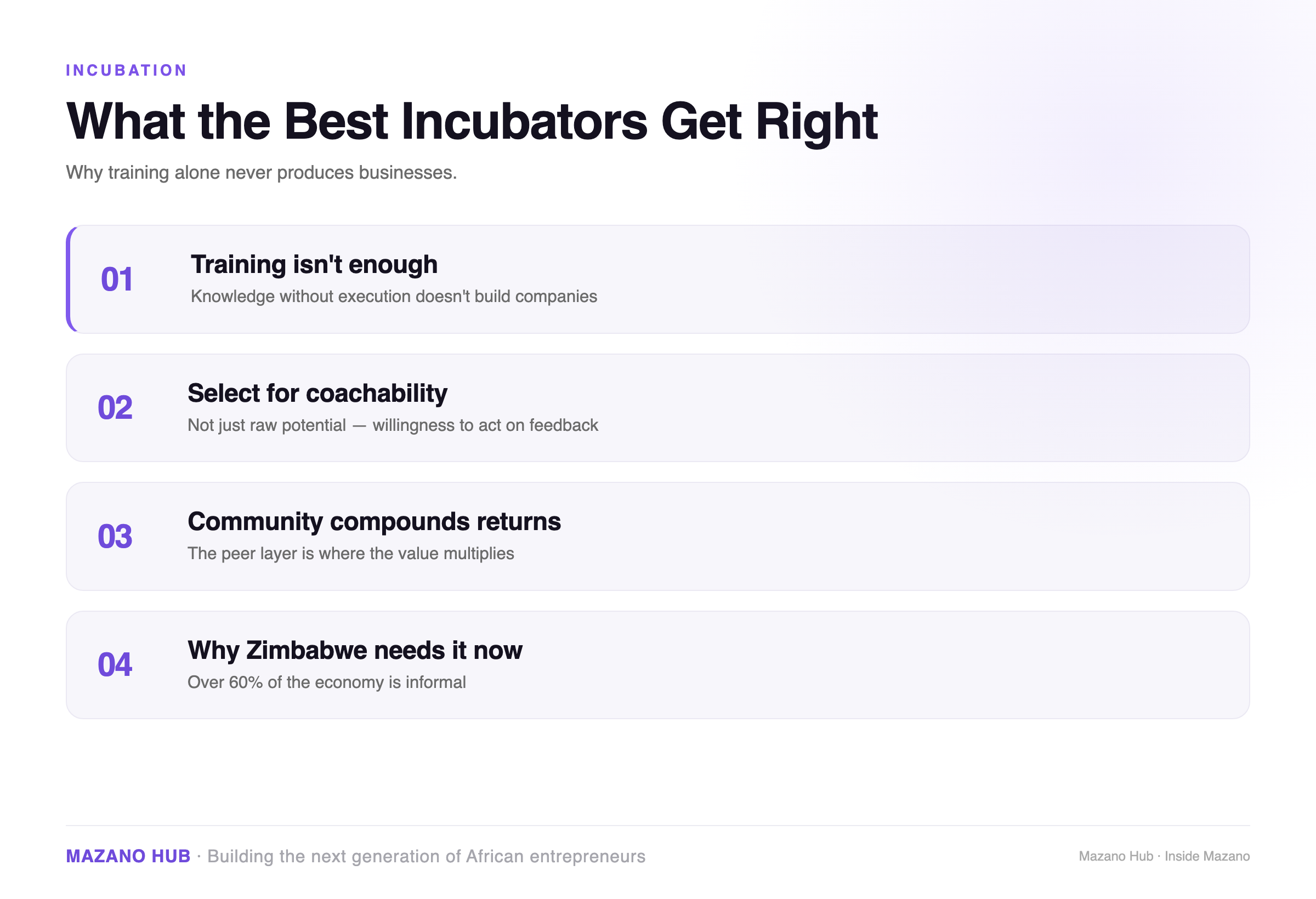
1. Training Alone Doesn't Produce Businesses
The most common failure in African incubators is the workshop model. Entrepreneurs come in for a weekend. They receive training on business planning, financial modeling, or marketing. They leave with a notebook full of notes and a certificate. Six months later, almost none of them have made meaningful progress on their businesses.
The problem is not the training content. It is the absence of accountability and application. Learning business concepts is not the same as building a business. The founders who progress fastest are the ones who apply what they learn within days — not months — of receiving it. They need structured moments to test assumptions, get feedback, fail safely, and iterate. One-time workshops cannot provide that rhythm.
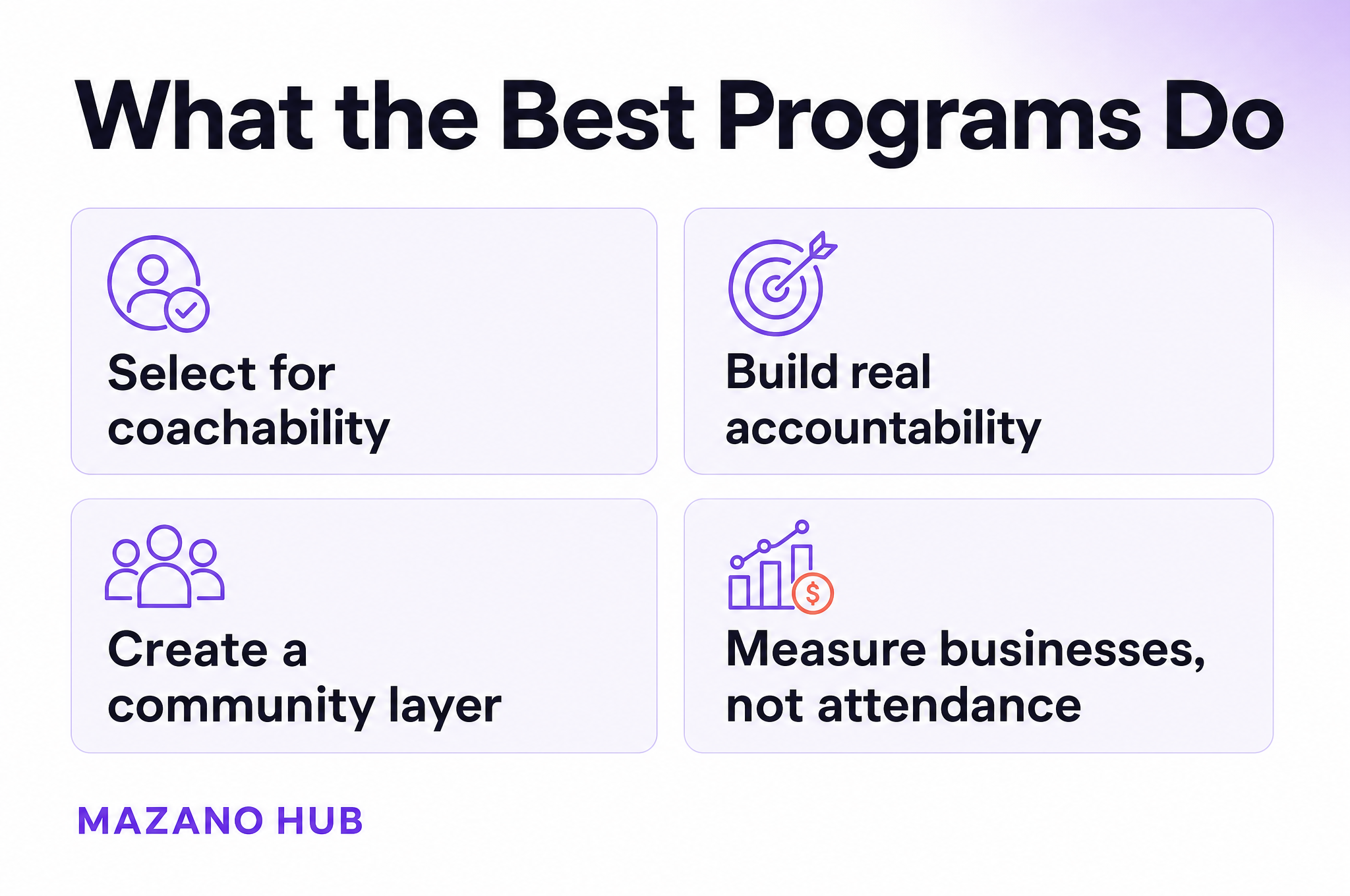
The programs that outperform embed training into an ongoing, time-bounded cohort experience. Each week builds on the last. There are real business tasks — not homework in the academic sense, but field work. Founders customer-test their assumptions. They run pilot sales. They have to report back on what happened. The program holds them accountable to doing the work, not just learning about it.
Structure creates the conditions where learning converts into action. That conversion is where incubators either earn their existence or don't.
|
|
|
2. The Best Programs Select for Coachability, Not Just Potential
Across Africa's most effective incubators — programs in Nairobi, Lagos, Cape Town, and Accra that have consistent track records of graduate success — a common selection philosophy emerges: they are not simply choosing the most promising ideas. They are choosing founders who are willing to be challenged, to abandon bad assumptions, and to apply what they learn.
The difference matters enormously. A talented founder with a strong business idea but an inability to take feedback will not benefit from a rigorous program. They will resist the hard moments — where the mentor pushes back on their revenue model, or where their first pilot fails and they need to reconsider their core assumption. Founders who can move through those moments are the ones who build.
Strong programs also select for commitment. Ten weeks of intensive participation is a real ask of someone who may be running a business, supporting a family, and navigating Zimbabwe's economic pressures simultaneously. Programs that select for founders who genuinely want to be there — not just those who want the credential — end up with cohorts that push each other and produce better outcomes for everyone.
Selection is not gatekeeping. It is program design. Getting it right means the entire cohort benefits — and graduates who go on to create jobs represent the return on that design investment.
|
|
|
3. The Community Layer Is Where the Return Compounds
The incubators with the longest track records share one feature that rarely appears in their public materials: a strong alumni community. The formal program ends after ten weeks or six months. The community never ends. Alumni refer each other customers. They invest in each other's businesses. They share supplier relationships, solve each other's HR problems, and show up at Demo Days to cheer the next cohort.
For African founders, this matters more than it might elsewhere. The informal networks that have historically funded and sustained African entrepreneurship — church savings circles, diaspora wire transfers, community market associations — operate on trust built over time. The best incubators accelerate that trust formation by deliberately structuring it into the cohort experience.
When founders go through a rigorous program together, they develop a bond that is qualitatively different from professional networking. They have seen each other's business models critiqued. They know which founder pivoted when their pilot failed and kept going anyway. That kind of shared history creates durable trust — and durable trust creates economic collaboration that extends a program's impact for years.
 What the Best Programs Do |
The community is not a side feature. For founders building businesses in resource-constrained environments, the community is often the most valuable thing the incubator provides.
|
|
|
4. Why Zimbabwe Needs This Model Now
Zimbabwe has over 60% of its economy operating informally. Youth unemployment is structurally high. Hyperinflation, currency instability, and infrastructure gaps — power outages that stretch 18 hours per day in many areas — make it harder to build a business here than almost anywhere else on the continent. And yet there are entrepreneurs building. Not because conditions are favorable, but because they have found ways to build under pressure.
What Zimbabwe's informal entrepreneurs most often lack is not drive or creativity. It is structure: a clear framework for testing and validating ideas before committing significant resources, a network of peers and mentors who have built under similar conditions, and access to non-dilutive capital to run their first real experiments. These are exactly the gaps a well-designed incubator addresses.
The informal sector is not a problem to be solved. It is a foundation to build on. The entrepreneurs inside it are already proving they can operate without infrastructure guarantees or institutional support. Give them structure, community, and a small amount of seed capital — and many of them will build businesses that cross into the formal sector, create jobs, and contribute to a tax base Zimbabwe needs.
Across every African market where well-designed incubators have operated for more than five years, the pattern repeats: structure and community, deployed with intention, produce businesses. The question for Zimbabwe is not whether this model works. It is whether enough people are willing to invest in it before the next generation of talent leaves for Johannesburg, London, or Toronto.
|
|
Mazano Hub — Cohort 1
Everything we have studied is reflected in how we have designed the Next Step Bootcamp. The 10-week cohort format is long enough to build real accountability rhythms and short enough to demand commitment. Our selection process asks about coachability, not just business ideas. And we are building the alumni community before Cohort 1 graduates, because we know the relationships formed inside the program will outlast the program itself.
Cohort 1 launches this quarter at our Harare facility — 716 Maple Street, Sunway City. We are accepting final applications and building the support infrastructure — mentors, micro-grants, and investor connections — that will serve these founders well past graduation. If you know an entrepreneur in Zimbabwe who should be in this cohort, connect them with us now.
|
|
|
Get Involved
Support Mazano Hub — help fund structure, community, and seed capital for Zimbabwe's next generation of entrepreneurs.
Visit Mazano.org
|
|
|
Mazano Hub | 716 Maple Street, Sunway City, Harare, Zimbabwe
mazano.org | [email protected]
You are receiving this because you support Mazano Hub's mission. | Unsubscribe
|
|