|
Mazano Hub
Earn Trust Fast:
|
||
|
Week of June 3, 2026 | Mazano Entrepreneurship Incubator | mazano.org |
||
|
Every founder in Zimbabwe faces the same invisible wall at the start: no one knows you yet. You have a product, a plan, and the drive to build something real — but your potential customers have been burned before. They've paid for promises that vanished. They've backed suppliers who disappeared. Trust is not a soft concept here. It is the first currency of commerce.
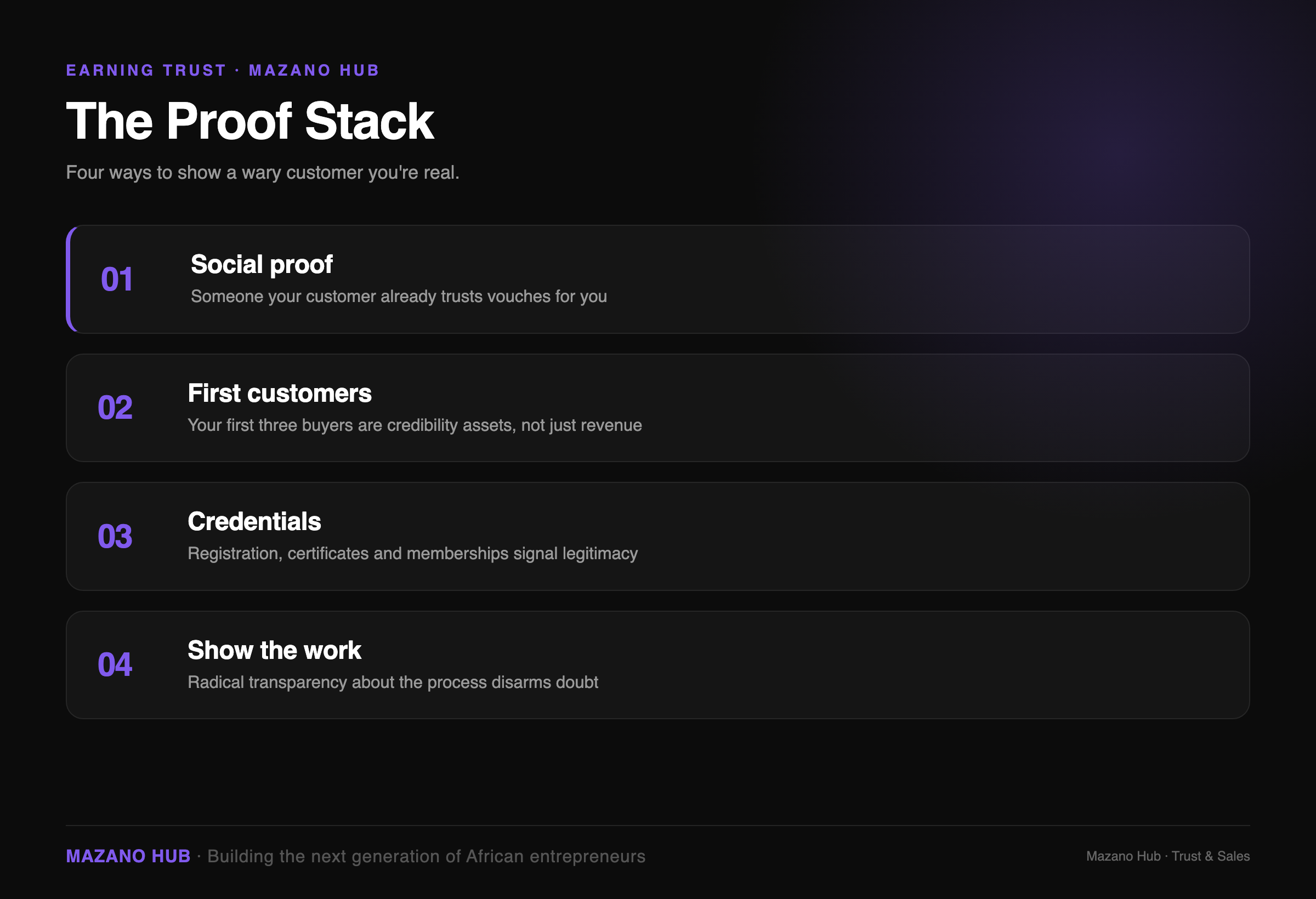
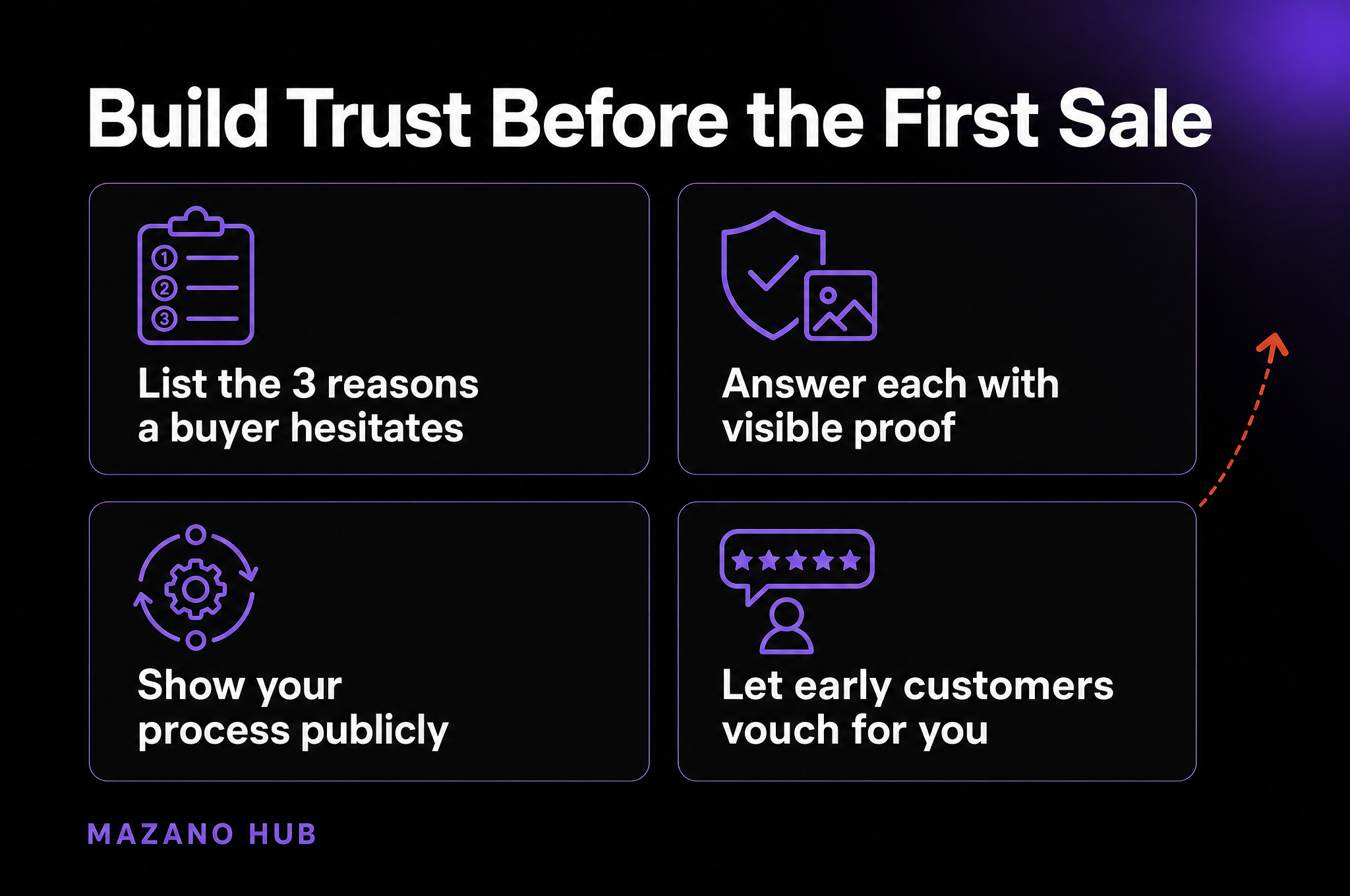
The good news is that trust is buildable. You do not need ten years of history, a corporate office, or a famous investor backing you. You need a deliberate strategy — one that signals reliability through consistent, visible action. This week's issue breaks down the four credibility levers that early-stage founders across Africa are using right now to close their first sales, land their first partnerships, and win over their first community of supporters. 1. Why Trust Is the First SaleBefore a customer hands over their money, they are making a different transaction entirely: they are deciding whether they trust you. In formal markets with strong consumer protection, buyers can recover from a bad decision. In Zimbabwe and across much of Africa, the cost of being wrong is much higher — so the bar for trust is correspondingly higher. Customers scrutinize you longer, ask more questions, and often need to see you operating in someone else's world before they enter yours. This is not an obstacle. It is a market reality you can design for. The founders who understand that trust is the actual product they are selling at the earliest stage — not the t-shirt, the service, or the software — move faster. They stop trying to sell features and start building familiarity. They show up consistently in the same spaces, speak to the same concerns, and demonstrate that they understand the person on the other side of the table. Practical implication: before your first sales conversation, ask yourself what signals of trust you have in place. Does your business have a phone number that gets answered? A WhatsApp that responds within the hour? A physical address or meeting point customers can verify? These are not nice-to-haves. They are the proof of life that makes the sale possible. 2. The Proof Stack: Four Ways to Show You're RealThere is no single credibility signal strong enough on its own. What works is a stack — multiple overlapping proofs of legitimacy that together create a picture of a real, operating, trustworthy business. Think of it as redundancy. Each layer compensates for a gap in the others. Social Proof Social proof is the oldest credibility tool: someone your customer already trusts has vouched for you. In African markets, this often means community leaders, church pastors, neighborhood associations, or family network connectors. Before you spend a dollar on advertising, spend your time earning the endorsement of one trusted voice in your target community. A single WhatsApp forward from the right person can outperform weeks of paid ads. Testimonials and Case Studies Your first three customers are not revenue milestones — they are credibility assets. Treat them that way. Serve them so well that they want to talk about it. Capture their experience in their own words: a voice note, a short video, a written WhatsApp message. Ask specifically what changed for them after using your product or service. These raw, authentic testimonials are more convincing than any polished marketing copy you could write. Credentials and Affiliations Formal credentials — a business registration certificate, a professional association membership, a program completion certificate — signal that you operate within recognized structures. You do not need an MBA. Being a registered member of your industry's trade association, displaying your ZIMRA registration number, or noting your participation in a recognized incubator program (like Mazano) all add layers to your credibility stack. Visible Work People trust what they can see. Share your work in progress: a finished product, a delivery in action, a workshop you ran, a problem you solved for a client. Photos and videos of actual work are worth more than the most beautifully designed logo. The goal is to make your business visible enough that a skeptical stranger can verify you are operational and serious before they ever make contact. 3. Show the Work, Not Just the PromiseOne of the most underused credibility strategies among African founders is radical transparency about the building process itself. When you share the behind-the-scenes of your business — the product development, the early mistakes, the problem you are solving and why — you build familiarity before a transaction ever happens. Familiarity is a prerequisite for trust. This does not require a following. It requires consistency. Posting three times a week to a WhatsApp business group of 40 people you know — sharing what you made, what you learned, what you are working on — builds a record of presence. After six weeks, those 40 people have seen you show up 18 times. That is enough to create the sense that you are a legitimate, active, invested person. That sense precedes trust. Process transparency also disarms common objections. If a customer worries about quality, show them how you make your product. If they worry about reliability, show them your order fulfillment process. If they worry about your longevity, show them you are still here next week, and the week after. The founder who documents their journey in real time is actively narrating their credibility into existence. One practical exercise: write down the three most common reasons a potential customer might hesitate to buy from you. Then design a piece of visible content that addresses each one directly. Not a sales pitch — evidence. Show, do not tell.
4. How Mazano Accelerates Your Credibility JourneyMazano was built on a specific understanding: the founders we work with do not lack capability — they lack the institutional credibility that formal systems confer. A brilliant entrepreneur in Harare without a university degree, a prominent family name, or a connected network faces credibility barriers that their talent alone cannot overcome. Mazano's role is to help close that gap. Being a Mazano Cohort 1 founder is itself a credibility signal. It tells investors, customers, and partners that this person was selected through a rigorous process, that their business model has been stress-tested, and that they are operating inside a structured support environment. The cohort name becomes part of the founder's proof stack. It is not just a program — it is an endorsement. Beyond the signal, Mazano's curriculum actively builds trust infrastructure. Founders learn to document their business systems, communicate professionally with customers and partners, handle conflict with integrity, and present their financials clearly. These are not soft skills — they are the operational behaviors that customers and investors read as trustworthiness. The incubator experience trains founders to behave like the credible businesses they are becoming. Faith is also part of this equation. Many Mazano founders come from Zimbabwe's church and community networks, where integrity and accountability are values held publicly — not just privately. Anchoring your business identity in those same values, and operating with the consistency they demand, is one of the most powerful credibility tools available. Your church community already trusts you. Build from there. |
||
|
||
|
|
||
|
Mazano Hub is a weekly newsletter from Mazano, a faith-driven entrepreneurship incubator supporting early-stage founders in Zimbabwe and across Africa. Visit us at mazano.org You are receiving this because you subscribed to Mazano Hub. Unsubscribe |