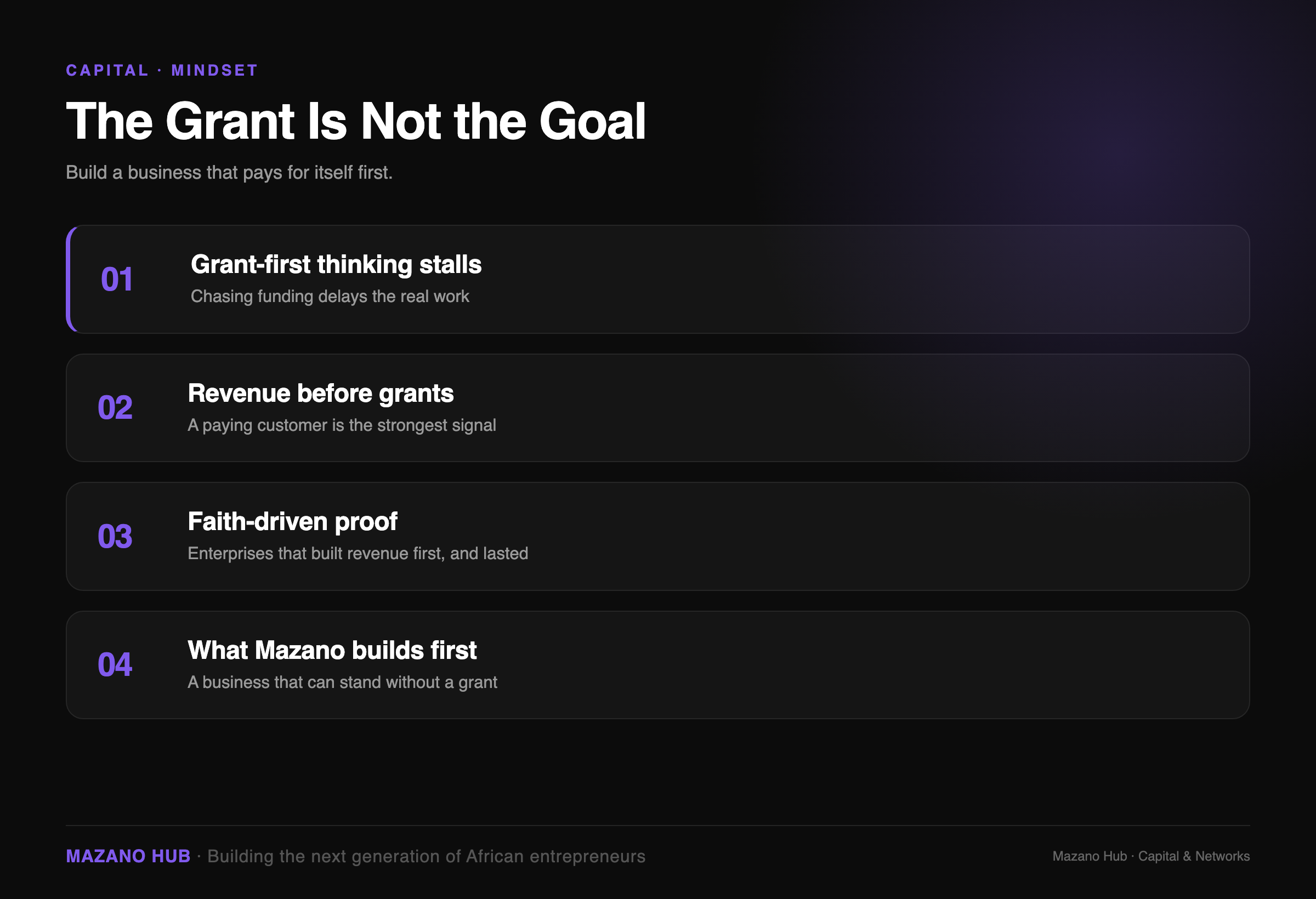
The Grant Is Not the GoalAfrican faith-driven entrepreneurs need revenue strategies, not funding dependency — and Mazano Cohort 1 is built around that truth. |
|
|
Ask a room of early-stage African entrepreneurs what they need most and a predictable answer surfaces: a grant. A government fund. A diaspora investor willing to write a check before the idea has a single paying customer. The narrative is seductive — external capital as the unlock, the missing piece that transforms potential into progress.
The trouble is, it is mostly wrong. And the founders who discover this early — who build their business backward from a paying customer rather than forward from a funding application — are the ones who end up building something that lasts. At Mazano, that insight is not a footnote. It is the foundation of everything we teach. |
|
Why Grant-First Thinking Stalls FoundersThe grant-first mindset is understandable. Resources are scarce. Formal credit markets in Zimbabwe — and across much of sub-Saharan Africa — are effectively closed to founders without collateral, credit history, or institutional backing. When a grant opportunity appears, it looks like a lifeline. Founders pivot toward it. But chasing grants before building revenue creates a cascade of hidden costs. The first is time. A grant application cycle — research, writing, submission, waiting, revision — can consume three to six months. During those months, the founder is not talking to customers, not iterating on the product, not building the execution muscle that separates businesses that survive from those that do not. The second cost is mission drift. Many grant programs have reporting requirements, thematic restrictions, and geographic focus areas that pull founders away from their original insight. A founder who started with a genuine solution to a local problem begins shaping her pitch — and eventually her product — around what funders want to fund, not what her community actually needs. The third cost is dependency. A business sustained primarily by grants never develops the feedback loops that revenue creates. Revenue tells you what customers value. Grants tell you what donors value. The two are often not the same. Founders who skip the revenue stage often find themselves relaunching their business from scratch after a grant cycle ends — without a customer base, without a product-market signal, and with depleted energy. |
|
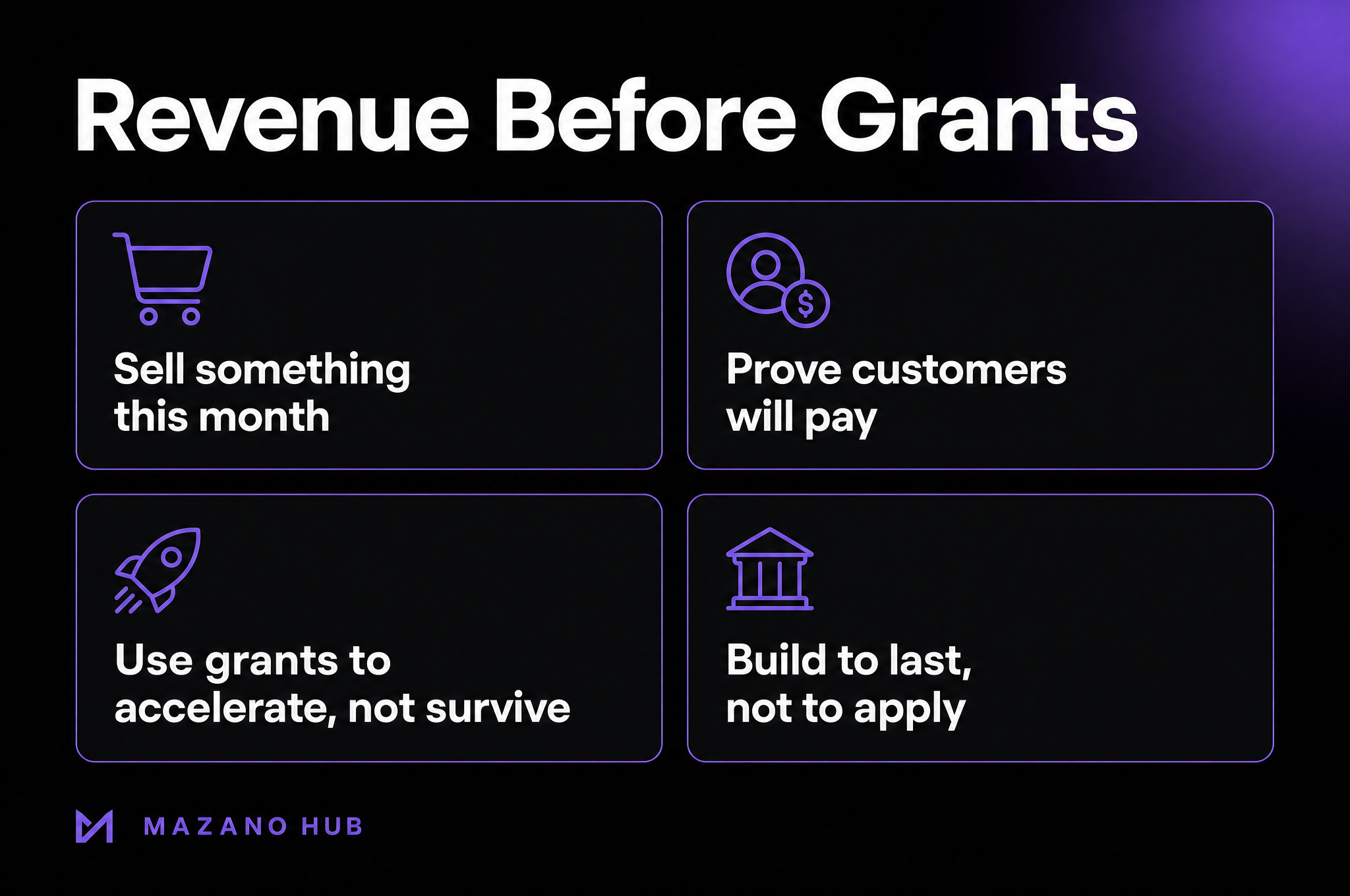
Revenue Before Grants: A Different Starting PointThe alternative is not to ignore grants. It is to sequence them correctly. Revenue first. Grants second — as acceleration fuel, not survival fuel. A founder who has demonstrated that real customers will pay real money for her product is a fundamentally different kind of grant applicant. She has evidence. She has a story grounded in market validation, not just vision. She knows her unit economics. When she walks into a grant review panel or an impact investor meeting, she is not asking someone to take a risk on an idea. She is asking someone to help scale something that already works. This approach also changes how founders relate to adversity. When your first revenue comes from a customer who chose you — not from a funder who was allocated a budget — you develop a different relationship with your product. Every piece of customer feedback becomes urgent, actionable signal. Every repeat purchase becomes proof that the model holds. That operational sharpness is impossible to simulate through a grant cycle. In the Zimbabwean context, this is especially powerful. Informal sector entrepreneurs across Harare, Bulawayo, and rural townships have been practicing revenue-first entrepreneurship for decades — out of necessity, not strategy. The opportunity for a structured program like Mazano is to take that ingrained hustle and add the frameworks, mentorship, and network that convert it into a scalable, bankable business. |
|
Faith-Driven Enterprises That Got It RightAcross Africa, some of the most durable social enterprises share a common thread: they were built around a revenue model before they were ever grant-funded. Their founders held a belief — often explicitly rooted in faith — that honest work, genuine service, and fair exchange were not just ethical positions but practical ones. Consider the trajectory of community-based agricultural cooperatives across East Africa that began as church-organized savings groups. They did not wait for a development NGO to fund them. They pooled what members already had, created a shared market, and built outward from a working internal economy. When international grant funding eventually arrived, it landed on a structure that already had discipline, governance, and a proven model. The grants accelerated; they did not create. In Zimbabwe, faith communities have long served as informal business incubators — rotating credit clubs (mukando), skill-sharing networks, bulk purchasing cooperatives. These informal structures embed the revenue-first mindset without naming it. What they often lack is documentation, formalization, and the kind of structured growth pathway that allows a $500 operation to become a $50,000 one. That is the gap Mazano was built to close. The lesson is not that grants are bad. It is that they work best when they land on a foundation that revenue has already built. Faith-driven founders understand this intuitively — stewardship means building something that sustains itself. A business that collapses the moment a grant cycle ends has not been good stewardship of anyone's resources.
|
|
What Mazano Cohort 1 Builds FirstMazano Cohort 1 is launching mid-2026, and the curriculum was designed with a deliberate sequence. In the first phase, participants do not write a single grant application. Instead, they build and test a minimum viable revenue model. That means identifying their most likely first paying customer, designing the simplest version of the product or service that customer would actually exchange money for, and going out to get that first transaction. This is not easy. It requires founders to confront uncomfortable truths about their assumptions early, when the cost of being wrong is low. It requires them to have real conversations with real people, not to polish a pitch deck for a panel of evaluators. It is the hardest and most valuable work of early-stage entrepreneurship. Once founders have demonstrated even a basic revenue signal — a handful of paying customers, a repeatable sale, a clear value proposition that someone voluntarily chose — the curriculum moves to growth frameworks, financial modeling, and yes, grant identification. By then, participants are not writing grant applications out of desperation. They are writing them from a position of strength, presenting evidence, and choosing funding partners whose values and focus align with the business they are already building. This is what makes Mazano different from general business training programs. We are not teaching entrepreneurship theory. We are training founders to do the work — grounded in faith, disciplined in practice, and accountable to a cohort of peers who are walking the same road. |
|
|
From Mazano The goal was never the grant. The goal is a business that changes a community, sustains a family, and compounds over a lifetime. Grants are tools. Revenue is the foundation. Cohort 1 is for founders who are ready to do the work. If that is you — or someone you know in Zimbabwe — applications are open now. |
|
|
|
|
|
|
|
MAZANO
Faith-driven entrepreneurship incubator · Zimbabwe
You received this because you subscribed to Mazano Hub. |