|
A founder in Harare spent three years applying to accelerators and pitching to venture capitalists. She got polite rejections, feedback about her market being too small, and advice to look for traction she did not yet have. Then she applied to a development finance institution focused on financial inclusion in Sub-Saharan Africa. She had a clear answer to one question: how many low-income people does your business serve, and how do you know?
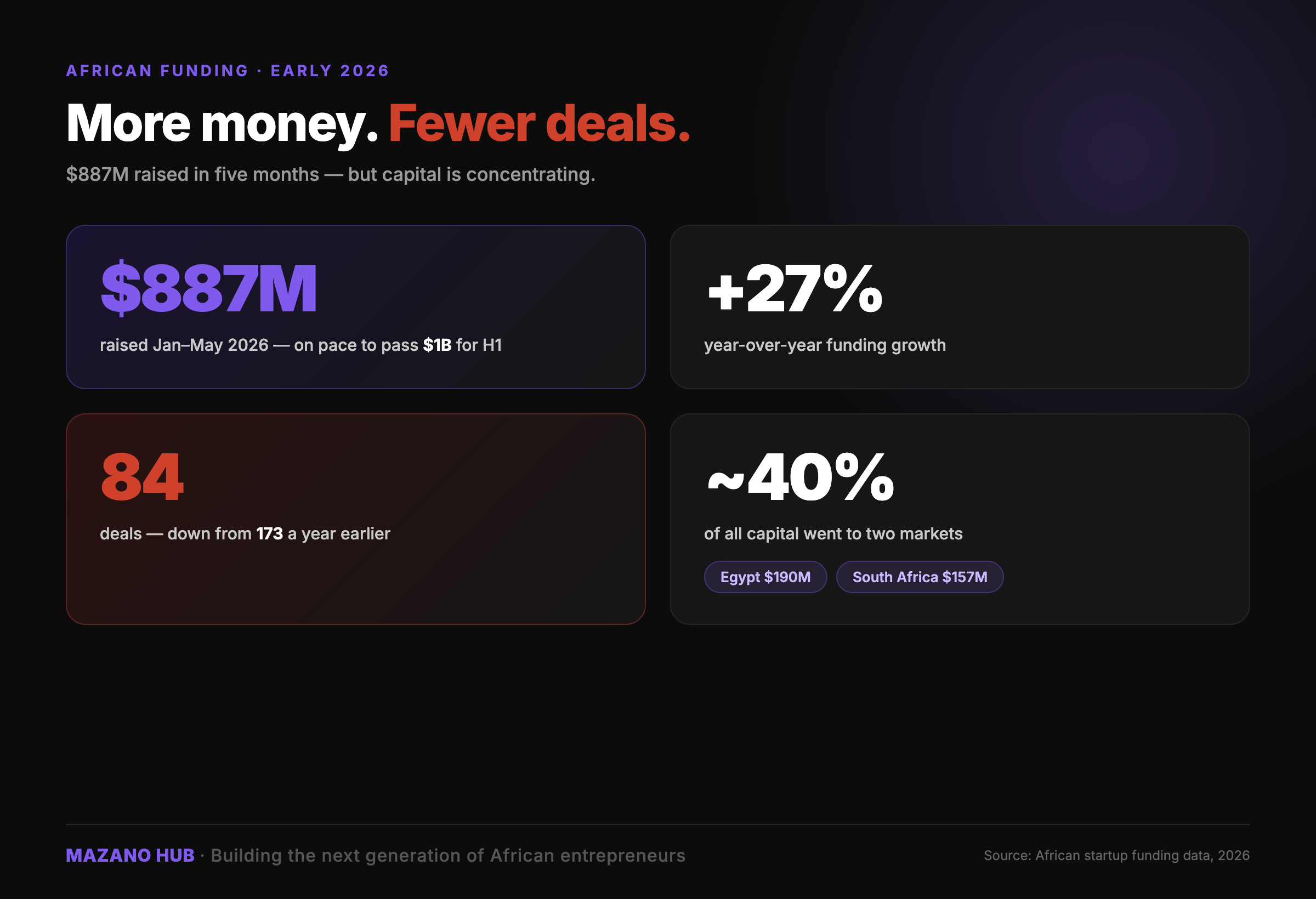
She got the meeting. Then the grant. Then the follow-on investment. The capital had always been there. She just did not know where to look — or how to speak the language of the funders who were actually writing checks for businesses like hers. African startup funding is surging in 2026, but the landscape has shifted dramatically. Understanding that shift is no longer optional for founders who want to grow. 1. The $887M Picture: More Money, Fewer DealsAfrican startups raised $887 million in the first five months of 2026, putting the continent on pace to cross the $1 billion mark for H1 — a milestone that would represent a 27% year-over-year increase. On the surface, this looks like an era of abundance. The numbers say capital is flowing. But the deal count tells a different story. Only 84 transactions were recorded in the same period, compared to 173 in the first half of 2025. That means roughly the same amount of money is moving through half the number of deals. Capital is concentrating. Fewer founders are receiving larger checks — and most early-stage founders are watching from the outside. Egypt attracted $190 million in disclosed funding; South Africa followed with $157 million. These two markets absorbed nearly 40% of all capital. Nigeria, Kenya, and Ghana continue to draw investor attention. Countries like Zimbabwe, Zambia, and Tanzania — home to large numbers of community-embedded, early-stage founders — remain underrepresented in the deal flow data. This concentration is not a reason to give up. It is a reason to understand which funders are still active at the early stage, what they want, and how to reach them. The founders who are succeeding in 2026 are the ones who stopped chasing traditional venture capital and learned to position themselves for a different kind of investor — one with different priorities, different timelines, and a different definition of success. 2. Who Is Actually Writing Checks in 2026Traditional venture capital from North America has retreated from African markets. The institutional funds, family offices, and return-driven VCs that were active in 2020–2023 have largely pulled back, citing portfolio pressure, carry concerns, and longer-than-expected exit timelines. The funds that remain from North America are predominantly government-linked or impact-oriented: the International Finance Corporation (IFC), the US International Development Finance Corporation (DFC), and institutional impact funds that measure success in terms of jobs created, communities reached, and economic inclusion advanced. Development Finance Institutions — DFIs — are now the dominant capital source for Sub-Saharan Africa at the growth and early-growth stages. These include the IFC, DFC, the African Development Bank's private sector arm, the European Investment Bank, and a range of bilateral DFIs from the UK (British International Investment), France (Proparco), Germany (DEG), and the Netherlands (FMO). Each has its own mandate, but most prioritize measurable development impact alongside financial sustainability. Beyond DFIs, the most active funders in 2026 for early-stage businesses include: diaspora angel networks that combine capital with mentorship; church and faith-aligned philanthropic funds that blend grants with impact investment; regional foundations focused on youth employment and women's economic empowerment; and a growing class of African institutional investors — pension funds, insurance companies, and sovereign wealth vehicles — beginning to allocate to domestic SME development. The common thread across all of these funders: they are not primarily asking "what is your exit strategy?" They are asking "what changes in people's lives because of your business?" That question is answerable by founders in Harare, Bulawayo, Kampala, and Kumasi — founders who may never reach the scale that traditional VCs require but who can absolutely demonstrate the community and economic impact that DFIs and impact investors demand. 3. What Impact Investors Actually Want From YouImpact investors evaluate proposals through a lens that most founders are not trained to use. Understanding that lens — and speaking it fluently — is what separates funded founders from unfunded ones in this market. The four metrics that matter most to DFIs and impact funds right now are: job creation and quality of employment, financial inclusion and access to services, gender equity and women's economic participation, and environmental or climate impact. Job creation does not just mean how many people you employ directly. It includes indirect jobs — the farmers you buy from, the suppliers you use, the downstream service providers your business activates. Impact investors use a multiplier framework. A founder who employs five people directly but sources inputs from 40 smallholder farmers has a significantly stronger impact narrative than that five-person number suggests. Know your full employment footprint. Financial inclusion is the question of whether your business brings people who are currently excluded from formal financial systems into contact with credit, savings, insurance, or other economic tools. A mobile money agent, a micro-lending platform, a savings group digitization service, a business that helps rural traders accept digital payments — all of these are inclusion businesses. Impact investors will ask for the numbers: how many previously unbanked or underbanked users have you reached? What has changed about their financial behavior? The overarching principle is this: impact investors want evidence, not assertion. They do not want to hear that your business "helps communities." They want to see the baseline — what was true before your business existed — and the delta — what is now measurably different. Founders who track this data from day one, even informally, have a decisive advantage when the time comes to raise capital. Start measuring now, even if you are not yet fundraising. 4. How to Position Your Business Before You Approach ThemPositioning for impact capital is not something you do the week before you submit an application. It is a process that takes three to six months of deliberate groundwork. The founders who get funded are the ones who did the work before the opportunity opened — and who arrive at the conversation with documentation, not intentions.
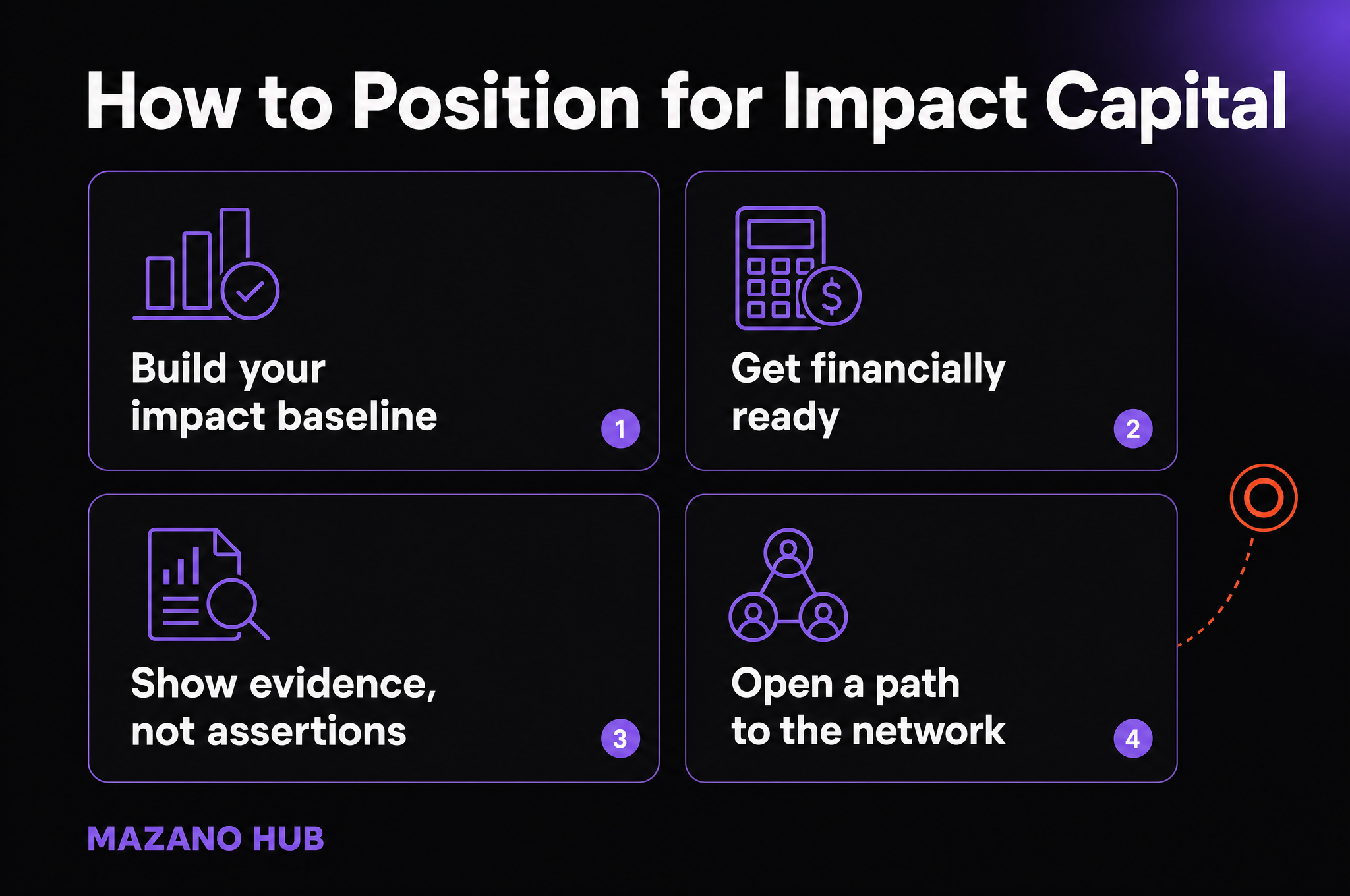
The first step is building your impact baseline. Document your current state: how many people does your business serve, what sector are they in, what was their situation before engaging with your product or service, and what has changed? Even if the numbers are small, having a documented baseline is far more credible than a projected estimate. Impact investors have seen too many "we will impact 1 million people" decks. They want "we have already impacted 200 people, here is how, here is what we measured, and here is what the next 2,000 looks like." The second step is financial readiness. DFIs and impact funds, even when offering grants or concessional loans, want to see that you can manage money responsibly. This means audited or reviewed financial statements if you have them, clear separation of personal and business finances, a basic financial model showing revenue assumptions and expense structure, and a credible use-of-funds explanation — not "for operations" but "specific product development, working capital for specific use, and market expansion into specific geography." The third step is network access. Most DFI and impact fund opportunities are not widely advertised. They circulate through intermediaries — accelerators, incubators, local development partners, chambers of commerce, and diaspora networks. Being inside one of these networks dramatically increases your chance of hearing about the right opportunity at the right time. This is where structured programs matter: not just for the curriculum, but for the connections. The founders who access impact capital in 2026 are not necessarily the most innovative or the fastest-growing. They are the most prepared. They have done the baseline work, they can tell a clear impact story with evidence behind it, and they are known within networks that surface the right opportunities. That kind of preparation is learnable. It is teachable. And it is exactly the gap that structured incubation programs exist to close. Mazano Cohort 1: Applications Open July 1Everything described in this article — impact baseline documentation, financial readiness, investor narrative, network access — is the curriculum of Mazano Cohort 1's Module 3: Capital and Networks. The six-month program launching September 2026 is designed specifically to prepare early-stage Sub-Saharan African founders for exactly this funding landscape. Cohort 1 accepts 10–15 founders. Participants receive structured bootcamp modules, one-on-one mentorship, micro-grant access ($25,000–$50,000 disbursed across the cohort), and direct connection to Mazano's network of donors, church partners, diaspora professionals, and impact-aligned investors. The program is faith-driven and community-rooted — built on the conviction that African entrepreneurs with strong local accountability structures and clear community impact are exactly the founders the impact capital world should be funding. Applications open July 1, 2026. If you are an early-stage founder in Sub-Saharan Africa — or if you know one — the window is open. The capital is there. The question is whether you will be prepared when it is your turn to ask.
|