|
There is a particular kind of business founder that investors in Nairobi, Lagos, and Harare have learned to watch closely. Not the one with the biggest pitch deck or the most sophisticated financial model. The one whose customers would feel a genuine loss if the business disappeared tomorrow.
That kind of founder is almost always building local-first. They know their customers by name. They source supplies from people they trust and who trust them in return. They price for the economic reality their community actually lives in, not the purchasing power they wish their customers had. When currency devalues, when a supplier disappears, when a logistics route becomes unreliable, these founders adjust quickly because their whole business model is grounded in relationships, not assumptions.
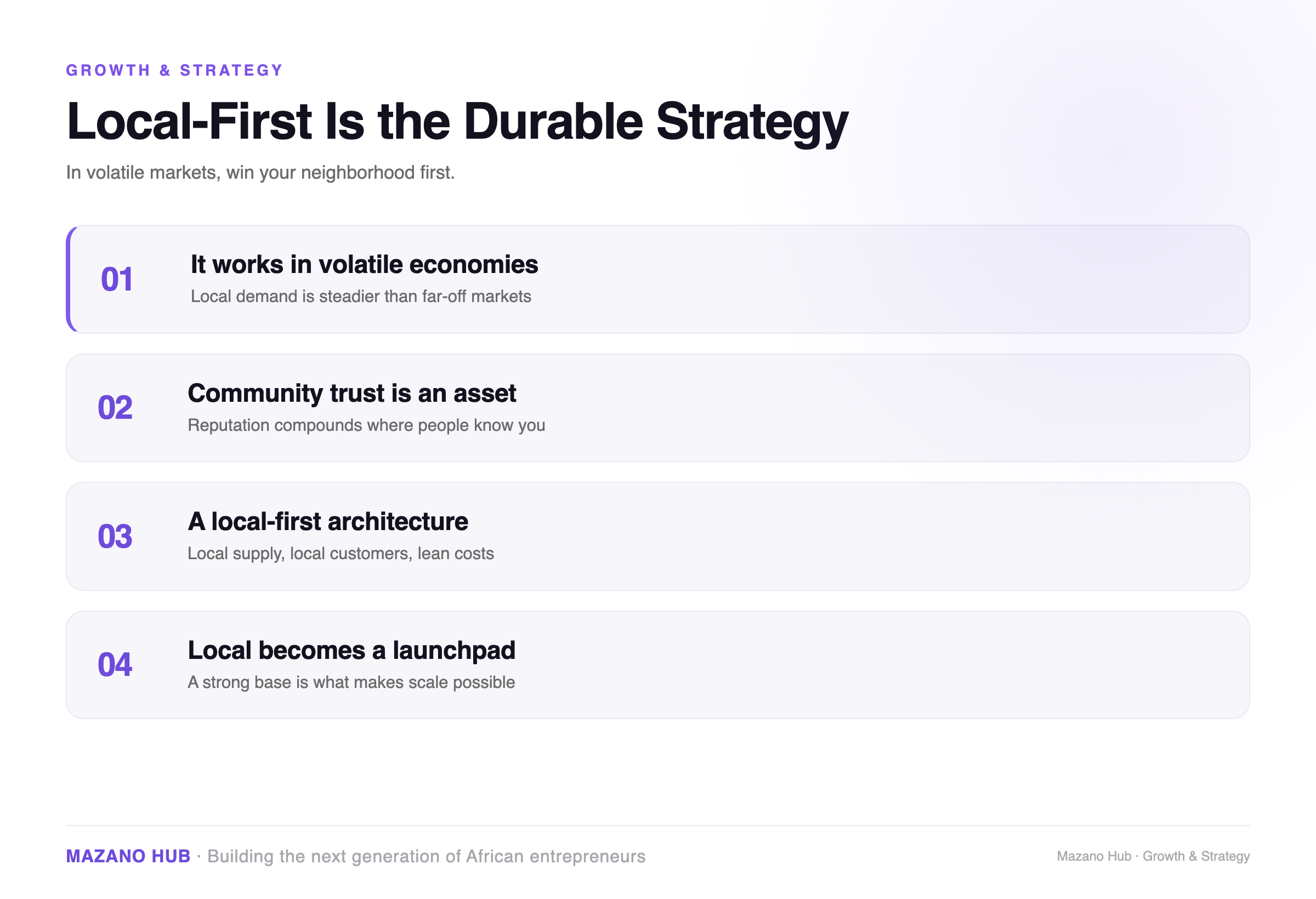
This is not a consolation prize for founders who cannot access global markets. It is a deliberate and powerful growth strategy. African entrepreneurs who go local-first are building the kind of durability that venture capital cannot manufacture and that external investment cannot shortcut. They are building businesses that belong to their communities and will endure because of it.
|
Why Local-First Works in Volatile Economies
Section 1
|
Zimbabwe's economy is one of the most instructive environments on earth for studying business resilience. Hyperinflation, currency controls, fuel shortages, and persistent power outages are not edge cases to plan for — they are the baseline operating conditions. Founders who have built businesses that survive here have learned something that founders in stable economies rarely need to learn: that revenue is worth nothing if you cannot collect it, and that suppliers are worth nothing if you cannot reach them.
Local-first strategies address both problems directly. A business that sells within its own community can collect payment in person, in cash, in mobile money, or in any combination that works for both parties. A business that sources locally — even partially locally — has supply chain resilience that cannot be disrupted by a distant port strike or a currency conversion problem. These are not abstract advantages. They are the difference between continuing to operate and shutting the doors.
There is also a demand-side argument. In economies with constrained household budgets, customers prefer businesses they trust over businesses that are merely convenient. That trust is built through repeated interaction, through consistency, through a reputation that travels through neighborhoods and church communities and family networks. A founder who has invested six months in building that local trust has an asset that a better-funded competitor cannot simply purchase.
Research from the International Finance Corporation has consistently shown that SMEs in Sub-Saharan Africa that prioritize local customer relationships and community-based distribution outperform peers in terms of survival rates over five-year periods. The resilience is not luck. It is structure. Local-first businesses are embedded in economic networks that absorb shocks differently than businesses dependent on external inputs and distant customers.
|
Building Community Trust as a Business Asset
Section 2
|
Community trust is the most misunderstood asset in African entrepreneurship. It is not the same as brand recognition. It is not built through advertising or social media presence. It is built through showing up consistently, delivering on promises, treating customers with dignity, and being seen as someone whose success is also the community's success. That last piece is not incidental — it is the key.
Founders who position themselves as community stakeholders — who hire locally, source locally, reinvest locally, and speak openly about what they are building and why — create a form of loyalty that is extremely difficult to compete against. Their customers become advocates. Their suppliers become partners. Their neighbors become informal referral networks. The business grows not primarily because of marketing, but because the community has adopted it as their own.
Faith communities are a particularly powerful channel for this kind of trust-building in Zimbabwe and across much of Sub-Saharan Africa. Church networks are among the most effective word-of-mouth distribution systems available to an early-stage founder. A business owner who is known and respected within their congregation — and who is seen to operate with integrity and generosity — will have referrals coming through channels that no marketing budget can replicate.
This is not exploitation of religious community. It is alignment. When a business genuinely reflects the values of service, honesty, and stewardship that faith communities hold, its presence in that network is natural. The founders at Mazano who understand this — who see their business as an expression of their faith as much as an economic endeavor — are the ones who build the deepest roots. Roots that hold when winds come.
|
The Practical Architecture of a Local-First Business
Section 3
|
Local-first is a philosophy that requires deliberate structural choices. It is not simply choosing to sell to nearby customers. It requires designing your entire operation around local realities — your pricing, your payment methods, your staffing, your supply chain, your communication style, and your customer service model.
Start with payment. In Zimbabwe, a business that only accepts card payments is excluding the majority of its potential customer base. A business that accepts EcoCash, cash in USD and ZWL, and informal credit arrangements for trusted customers is accessible to nearly everyone. That accessibility is a competitive moat. Payment flexibility signals that you understand your customers and have designed your business for them, not for your own convenience.
Pricing is equally critical. Local-first businesses price for real purchasing power, not aspirational purchasing power. This requires honest market research — not surveys, but actual conversations with real customers about what they can afford and what they are currently spending on competing alternatives. Founders who price correctly for their market from the beginning avoid the painful and often fatal process of having to lower prices later after burning through early revenue.
Distribution in local-first businesses often runs through informal channels: trusted stockists, market vendors, church groups, neighborhood associations, and cooperative buying networks. These channels have lower cost than formal retail and often higher reach within specific communities. Mapping these channels before launch — and building relationships with the people who run them — is one of the highest-return activities an early-stage African founder can do. It is also the work that most business programs skip because it is slow, relationship-intensive, and invisible to outside observers.
|
When Local-First Becomes a Launchpad for Scale
Section 4
|
One of the most persistent misconceptions about local-first growth is that it is the opposite of scale. It is not. It is the prerequisite for durable scale. The African founders who have built the most successful continental businesses — Twiga Foods in Kenya, Flutterwave in Nigeria, Sokowatch across East Africa — all built from deep local understanding before expanding. Their local roots gave them the operational knowledge, the customer insight, and the unit economics that made scaling possible without losing the plot.
 Build a Local-First Business |
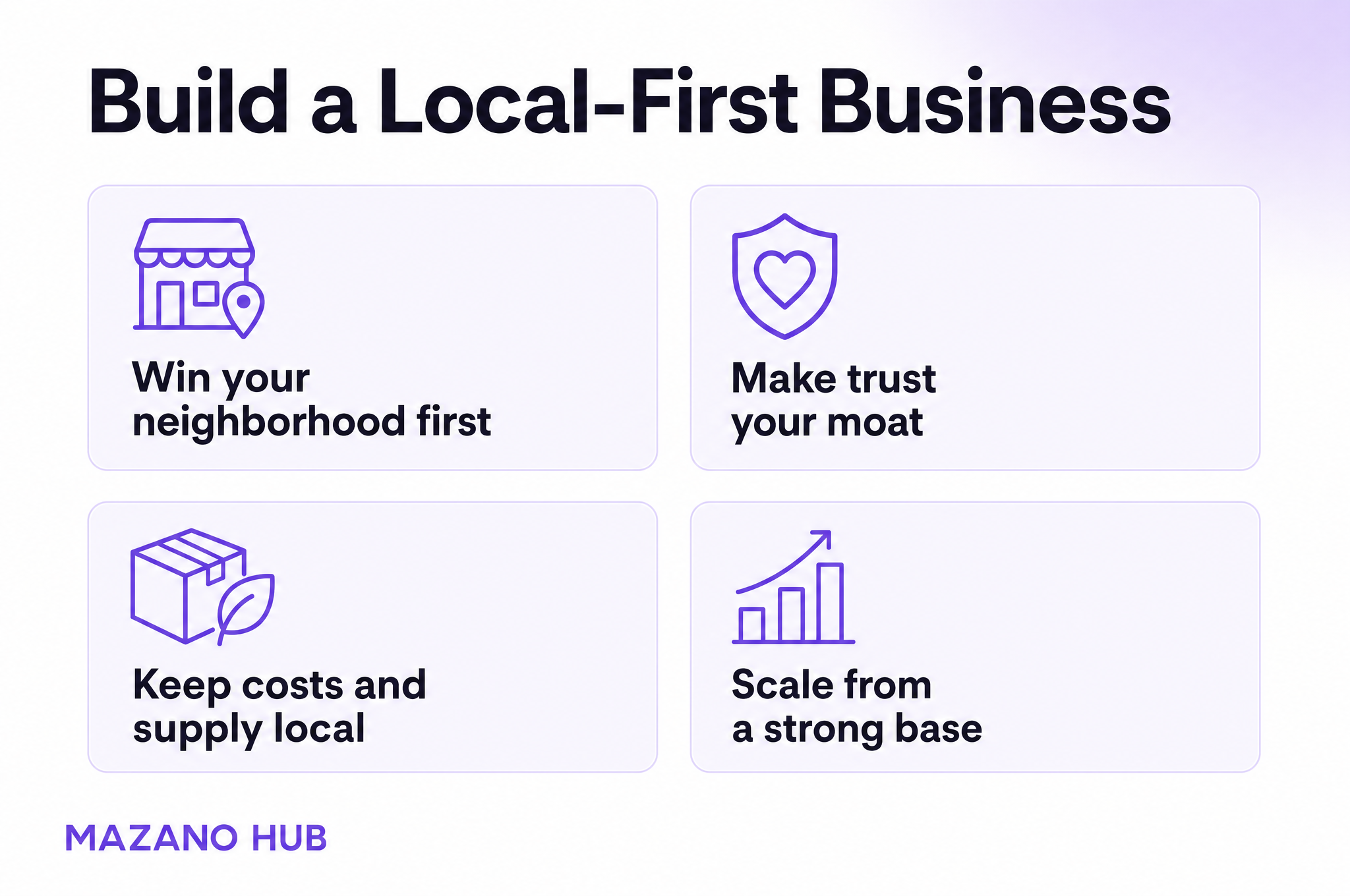
The pattern is consistent: master one market deeply, demonstrate that the model works and can be replicated, then carry the operating principles into adjacent markets. Founders who try to skip this step — who launch with ambitions for ten cities before they have proven anything in one neighborhood — almost always fail to reach the scale they intended. They run out of capital, credibility, or both before the model is actually proven.
Local-first also produces better data. A founder who has genuinely served 200 customers in Sunway City knows exactly what those customers value, what they will pay, and what keeps them coming back. That knowledge is an investor-grade asset. It cannot be fabricated by projections or market research reports. When that founder stands in front of an investor and describes their customer acquisition cost, their repeat purchase rate, and the referral patterns in their community, it carries a credibility that a theoretical business plan never will.
The transition from local mastery to broader scale is not a leap. It is a series of steps, each grounded in evidence and relationships built carefully over time. For the entrepreneurs who have done the local work honestly, those steps become available. For those who skipped the local work, scale remains an ambition that the business cannot support.
|
|
Mazano Perspective
At Mazano, local-first is not just a business strategy we teach — it is the foundation of how we are building this organization. Our facility in Sunway City, Harare, is not a neutral venue. It is a stake in the ground. It says: we are here, we are committed to this community, and we are building something that belongs to this place.
Cohort 1 participants will spend ten weeks learning to apply these principles to their own ventures. Customer discovery in real markets, not hypotheticals. Pricing conversations with real buyers. Distribution mapping through the actual channels their communities use. The goal is not to produce founders who can talk about local-first strategy. It is to produce founders who have practiced it, tested it, and built initial proof through it.
Cohort 1 recruitment opens July 1, 2026. If you know early-stage founders in Zimbabwe or Sub-Saharan Africa who are building ventures grounded in their communities and ready to go deeper, we want to hear from them. The next generation of durable African businesses is being built right now, in neighborhoods and markets and church communities across the continent. Mazano exists to help those founders go further.
|
|
|
Cohort 1 — Applications Open July 1
Know a founder ready to go local-first?
Early-stage entrepreneurs in Zimbabwe and Sub-Saharan Africa. Free 10-week bootcamp. Micro-grant funding. Mentor matching. Investor introductions.
Learn More at mazano.org
|
|
|