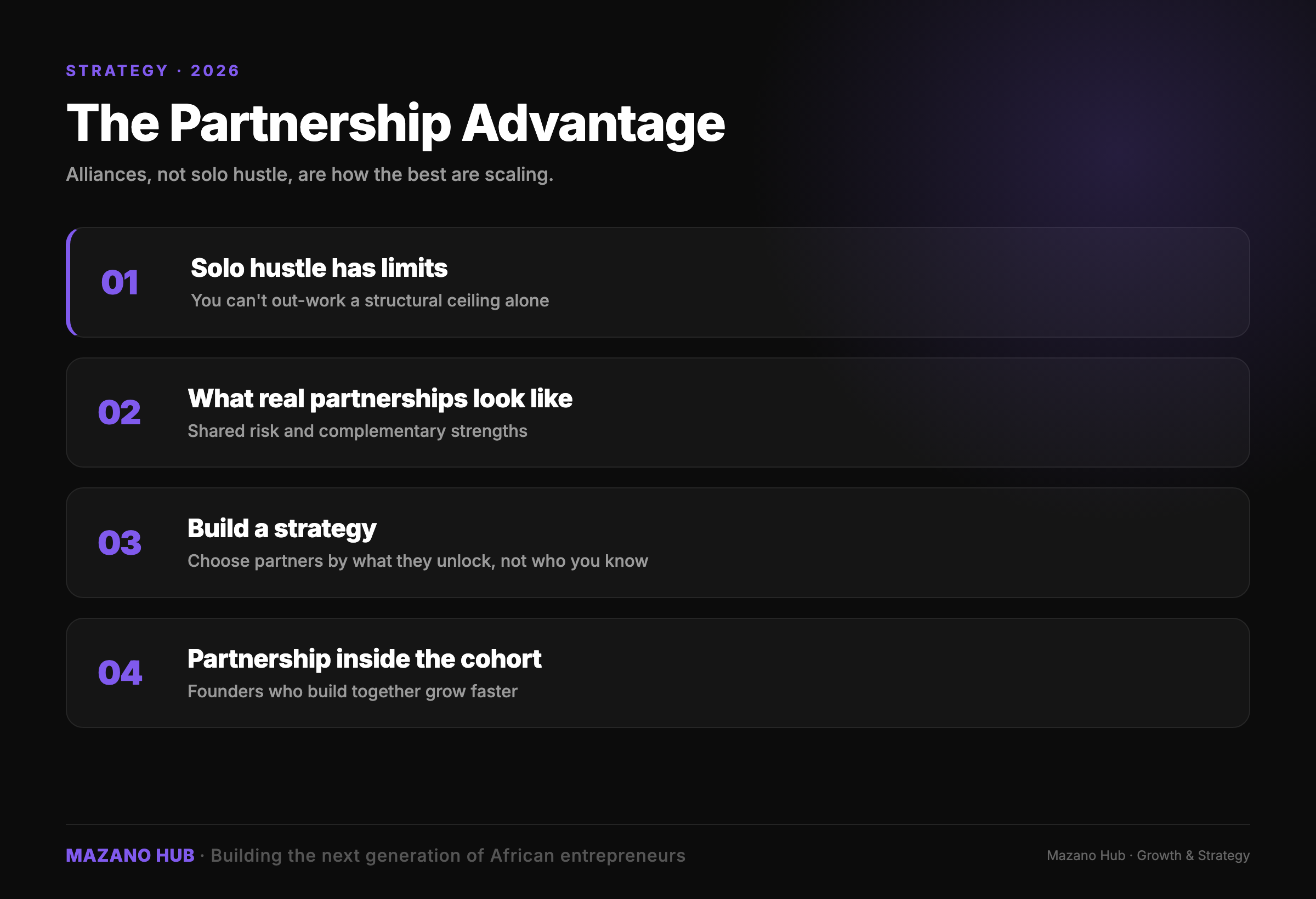
The Partnership Advantage for African FoundersStrategic alliances — not solo hustle — are how Zimbabwe’s best businesses are scaling in 2026. |
|
|
There is a story we tell ourselves about entrepreneurship. It is the image of the lone founder — sleepless nights, grinding alone, refusing to ask for help because asking feels like weakness. In Zimbabwe’s culture of self-reliance and hustle, this story has deep roots.
But it is the wrong story. Across the continent, the founders who are building durable businesses — not just surviving but growing with intention — are doing it through partnerships. Supplier alliances, peer accountability networks, church-community referrals, co-founder relationships, and strategic collaborations with other small businesses. The path forward is not solo. It never was. This week, we look at why the partnership advantage matters for African founders in 2026, what real partnerships actually look like at the early stage, and how to start building yours. |
|
Why Solo Hustle Has LimitsThe solo-founder model is expensive. Not just emotionally — financially. When one person tries to do sales, operations, product development, accounting, and customer service simultaneously, quality suffers everywhere. Skills gaps widen. Opportunities get missed simply because there are not enough hours in the day. In Zimbabwe’s operating environment, the cost of going alone is even higher. Access to capital is constrained. Power outages disrupt production. Informal market dynamics mean reputation and relationships determine whether customers return. A founder working in isolation has no buffer when one of these variables shifts. The deeper problem is that solo hustle creates a business that is entirely dependent on one person. That is not a business — it is a job with unpaid overtime. Scaling requires systems, and systems require people. Partnerships are how early-stage founders begin building those people-networks before they can afford full-time hires. Research across African SME markets consistently shows that founders who belong to peer networks, formal or informal, survive the first three years at significantly higher rates than those who work in isolation. Connection is a competitive advantage. It always has been. |
|
What Real Partnerships Look LikeWhen founders hear “partnership,” they often imagine formal joint ventures with legal agreements and shared bank accounts. That can be true — but partnerships at the early stage are usually much simpler. And the simpler they are, the faster you can build them. A supplier partnership is when you commit to buying consistently from one vendor in exchange for priority stock and slightly better pricing. A referral partnership is when you and a complementary business agree to send customers to each other. A resource-sharing partnership is when two founders split the cost of equipment, storage, or a delivery vehicle. A peer partnership is a structured accountability relationship — two founders who review each other’s numbers and hold each other to commitments. Church-community networks in Zimbabwe are one of the most underutilized partnership channels available to faith-driven founders. A congregation is a ready-made community of trust. When a business owner in that community delivers quality work and lives their values openly, word spreads faster than any social media post. That is not just marketing — it is a relational distribution network. The best early-stage partnerships are built on a simple question: what does this person or organization need, and what do I have that can serve that need? Value exchange — not charity, not favors — is the foundation. |
|
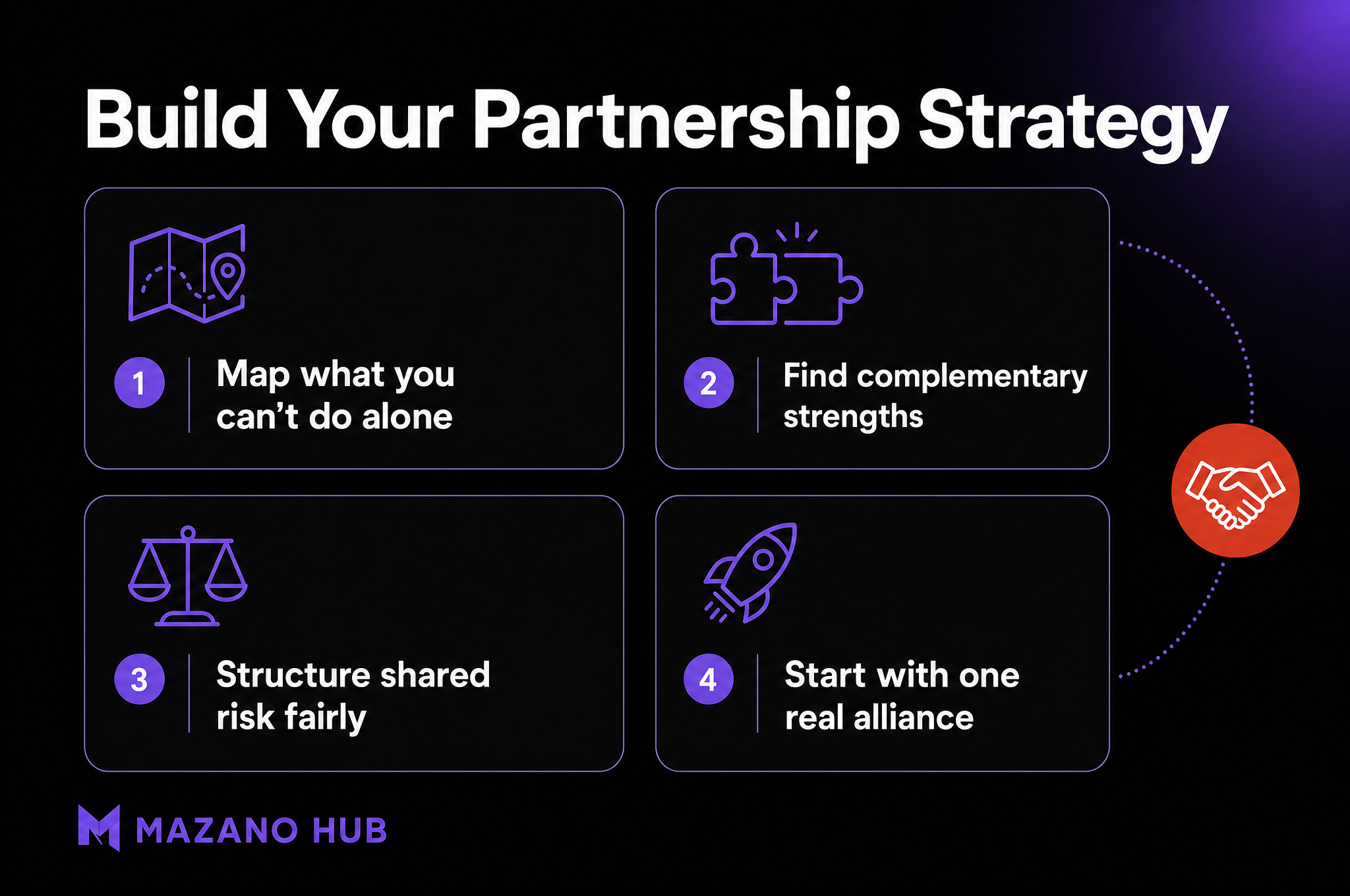
Building Your Partnership StrategyMost founders wait for partnerships to happen organically. The right approach is intentional: map the relationships you need, identify the people who can fill those roles, and create clear value propositions for each potential partner. Start with a partnership audit. Write down the five biggest bottlenecks in your business right now — the things that slow you down, cost you money, or limit your ability to serve customers. Now ask: which of these could be solved or reduced by a relationship? That is your partnership shortlist. When you approach a potential partner, lead with their benefit, not yours. “I want to send you customers who need what you offer. Here is what I would ask in return” is far more compelling than “I need help with X.” Even at the early stage, show up as someone who is giving, not just asking. Write it down. Partnerships that live only in verbal agreements rarely survive conflict or ambiguity. A one-page summary of what each party commits to — no lawyers required — creates clarity and accountability. Revisit it quarterly. Strong partnerships evolve as both businesses grow.
Finally, invest in the relationship before you need it. Show up for your partners’ events. Refer customers without keeping score. Check in when things are going well, not just when you need something. The founders who build the best partnerships treat them like they would a friendship — with consistency, generosity, and long-term thinking. |
|
Partnership Inside the CohortAt Mazano, we believe the most powerful partnership a founder can have in their first year is with another founder who is a few steps ahead of them, or walking beside them on the same path. That conviction shapes how we designed Cohort 1. Cohort 1 participants will work through structured partnership workshops in weeks five through eight of the 12-week Next Step Bootcamp. They will map their partnership needs, practice value-exchange conversations, and draft simple partnership frameworks for at least two relationships they plan to build post-program. Beyond the curriculum, the cohort itself is a partnership resource. Ten founders in the same room, each with different skills, networks, and customer relationships, represent real potential. Referrals, resource sharing, skill trades, co-marketing — these are not hypothetical. They are transactions we expect to see happen inside and beyond the program. Proverbs 27:17 says, “As iron sharpens iron, so one person sharpens another.” This is not just a verse we put on the wall. It is the operating principle behind how Mazano builds its cohorts. Founders who enter as individuals leave as a network. That network is one of the most durable things they will take from the program. Cohort 1 launches mid-2026. If you are an early-stage entrepreneur in Zimbabwe ready to build with intention, to learn in community, and to leave with a real peer network and a clear growth plan, this program was designed for you. |
|
|
|
|
MAZANO HUB Faith-driven entrepreneurship. Zimbabwe and beyond. 716 Maple Street, Sunway City, Harare, Zimbabwe | mazano.org You are receiving this because you subscribed to Mazano Hub updates. | Unsubscribe |