|
Mazano Hub Storytelling Sells: How African Founders Win Customers and InvestorsYour origin story is one of your most powerful business assets — here's how to find it and use it. |
||||
|
Mazano Hub Weekly · May 28, 2026 · Faith-Driven Entrepreneurship in Africa |
||||
|
Every founder has a moment they return to — the day they saw the gap no one else was filling, the year a family member could not access a service that should have existed, or the season when they decided enough was enough. That moment is not just personal history. It is the seed of your brand.
In markets like Zimbabwe, where trust is currency and relationships drive decisions, story is not just marketing — it is strategy. Yet most early-stage founders treat their backstory as a preamble before the "real" pitch begins. They rush past it to get to features, prices, and projections. That is a costly mistake. Across Africa's most successful ventures — from small retail shops to regional technology companies — founders who can tell their story clearly win customers faster, attract stronger partners, and raise money more effectively than those who cannot. Here is how to build and use yours. |
||||
|
|
||||
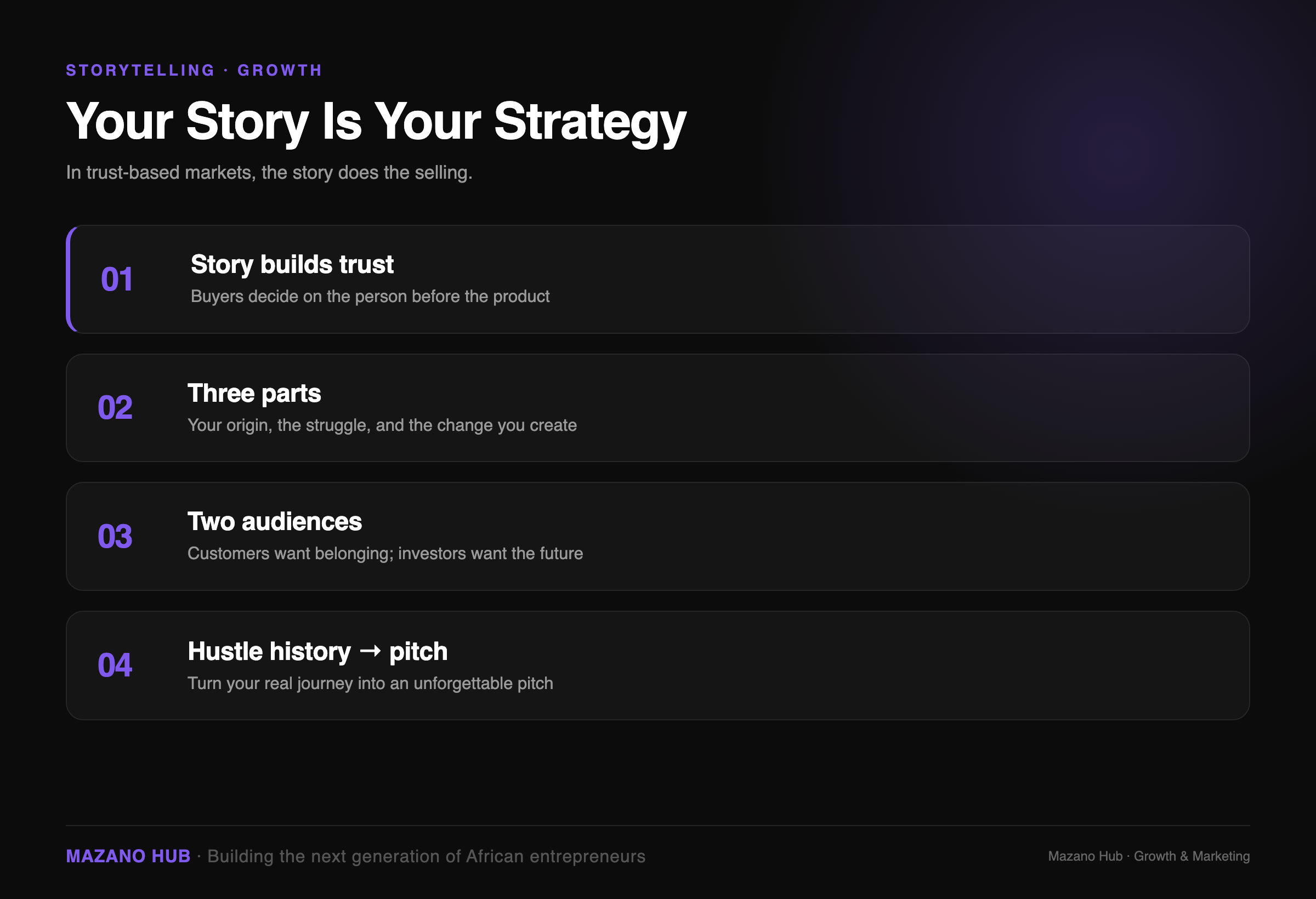
Why Your Story Is Your StrategyIn business school textbooks, competitive advantage comes from price, product differentiation, or market timing. Those matter. But in the African context — where most founders operate in informal or semi-formal markets with limited capital and where buyers make decisions based on personal trust — story is a category advantage all by itself. Think about how a woman in Harare decides which tailor to hire, which clinic to trust, or which hardware supplier to call back. In most cases, she already knows the person or someone who does. She has heard a recommendation. She has a sense of who they are and why they do what they do. That sense — that feeling of knowing a business from the inside — is story doing its work. Competitors can copy your product. They can undercut your price. They cannot copy your story. The specific combination of where you came from, what you witnessed, and why you decided to build — that is entirely yours. When you articulate it clearly and consistently, customers stop seeing you as a vendor and start seeing you as a person with a mission they can believe in. That is the shift that earns loyalty, not just transactions. Founders who understand this spend less on advertising and more on relationships. They generate referrals because their customers feel like they are part of something. And they attract investors and grant-makers who are looking for a reason to say yes — and find it in a founder whose "why" is undeniable. |
||||
The Three Parts of Every Founder StoryA founder story does not need to be long. It needs to be true, specific, and structured. The clearest ones follow a pattern that listeners can follow even when hearing it for the first time. Part One: The Problem You Lived. Not the problem you observed from the outside — the one you actually experienced. If you started a logistics company, tell us about the shipment that disappeared and how nobody helped you find it. If you built an agri-input supply service, tell us about the season your family's crop failed because the right seeds were unavailable in your district. Specificity is what makes this part land. Vague suffering is forgettable. A specific loss is unforgettable. Part Two: The Moment of Clarity. There was a turning point — a conversation, a discovery, a decision — when you stopped waiting for someone else to fix the problem and decided you would. Describe it. This is the pivot in your story where passive sufferer becomes active builder. It is also the part that answers the investor's question: why you? Part Three: The Solution You Built. What you are building now, framed as your answer to what you lived. Not a feature list — a response. "Because I watched my mother lose three months of income to informal money-lenders who had no accountability, I built a group savings platform with transparent records that community members could audit themselves." That is a solution story. It connects what you are building directly to what you have lived. |
||||
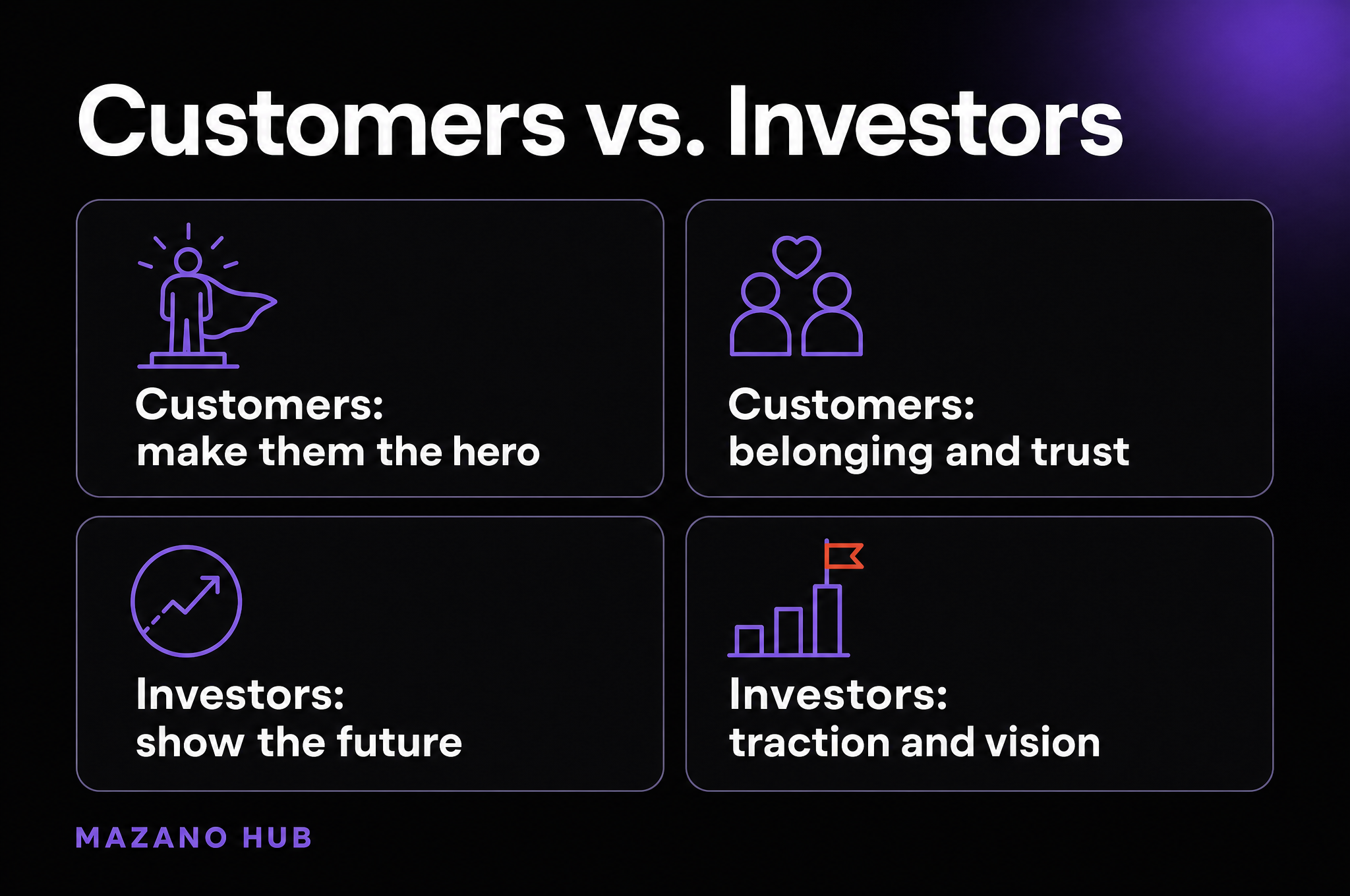
Storytelling for Customers vs. Storytelling for InvestorsThe same underlying story serves different audiences — but it must be adapted for each. Conflating customer storytelling with investor storytelling is one of the most common mistakes early-stage founders make. When you are talking to customers, your story should make them feel understood. The focus is on the problem they share with you. You are not trying to impress them with how far you have come — you are showing them that you know exactly what they are going through, because you have been there. The customer wants to feel: "This person gets it. This person built something for me." When you are talking to investors or grant-makers, the emphasis shifts. They want to see evidence of insight, conviction, and market understanding. They are asking: Is this founder the right person to solve this problem? Does she have a depth of understanding that gives her an edge? Your story becomes your answer to those questions. The problem you lived, the clarity you developed, and the solution you designed all demonstrate why you see what others miss. For faith-based funders and church partners — a critical audience for Mazano founders — your story takes on another dimension. It is not just about insight and market fit. It is about call and purpose. These funders want to know that the work is grounded in more than ambition. When your story connects personal experience to a broader sense of purpose and service, it speaks directly to why faith-motivated donors give.
|
||||
From Hustle History to Unforgettable PitchThe most common reason founders do not tell their story is that they do not believe it is impressive enough. They think: "I started selling shoes from a backpack. I do not have a dramatic founding story." They are wrong. The story does not need to be dramatic. It needs to be true and clear. Here is a practical exercise. Write down the answers to three questions without editing yourself: What is the most frustrating thing that happened to you in the space where you now operate? What made you decide to do something about it? What would success look like for the people you serve — in specific, human terms? Read what you wrote. That is your raw story. Now edit for clarity and brevity, not for impressiveness. Once you have the story down on paper, practice saying it out loud in 90 seconds. Then in 30 seconds. Then in one sentence. You will use different versions in different contexts — a networking event, a grant application, a WhatsApp introduction, a website about page. The core stays the same. The length and emphasis adapt. The founders who get traction in their first 12 months are usually not the ones with the best-funded business plans. They are the ones who can clearly answer the question: why you, why this, why now? A well-told story answers all three questions at once. It is worth spending real time getting it right — not once, but iterating it the way you iterate your product. |
||||
|
Mazano Cohort 1 At Mazano, we believe every Zimbabwean entrepreneur has a story worth telling — and that learning to tell it well is as important as any other business skill. That is why Cohort 1, launching mid-2026, includes a dedicated founder storytelling module as part of our core curriculum. We are not just teaching pitch decks. We are helping founders understand what they have lived, why it matters, and how to communicate it to the people who need to hear it most. We are still accepting applications for Cohort 1. If you know a founder in Zimbabwe — or are one yourself — whose experience has given them real insight into a problem their community faces, we want to hear from you. |
||||
|
Ready to Build With Us? Apply for Mazano Cohort 1Applications are open for early-stage Zimbabwean entrepreneurs. Faith-driven. Community-focused. Cohort launches mid-2026. Apply at mazano.org |
||||
|
Know a founder who needs to hear this? Forward this newsletter or share the link at mazano.org. |
||||
|
||||