|
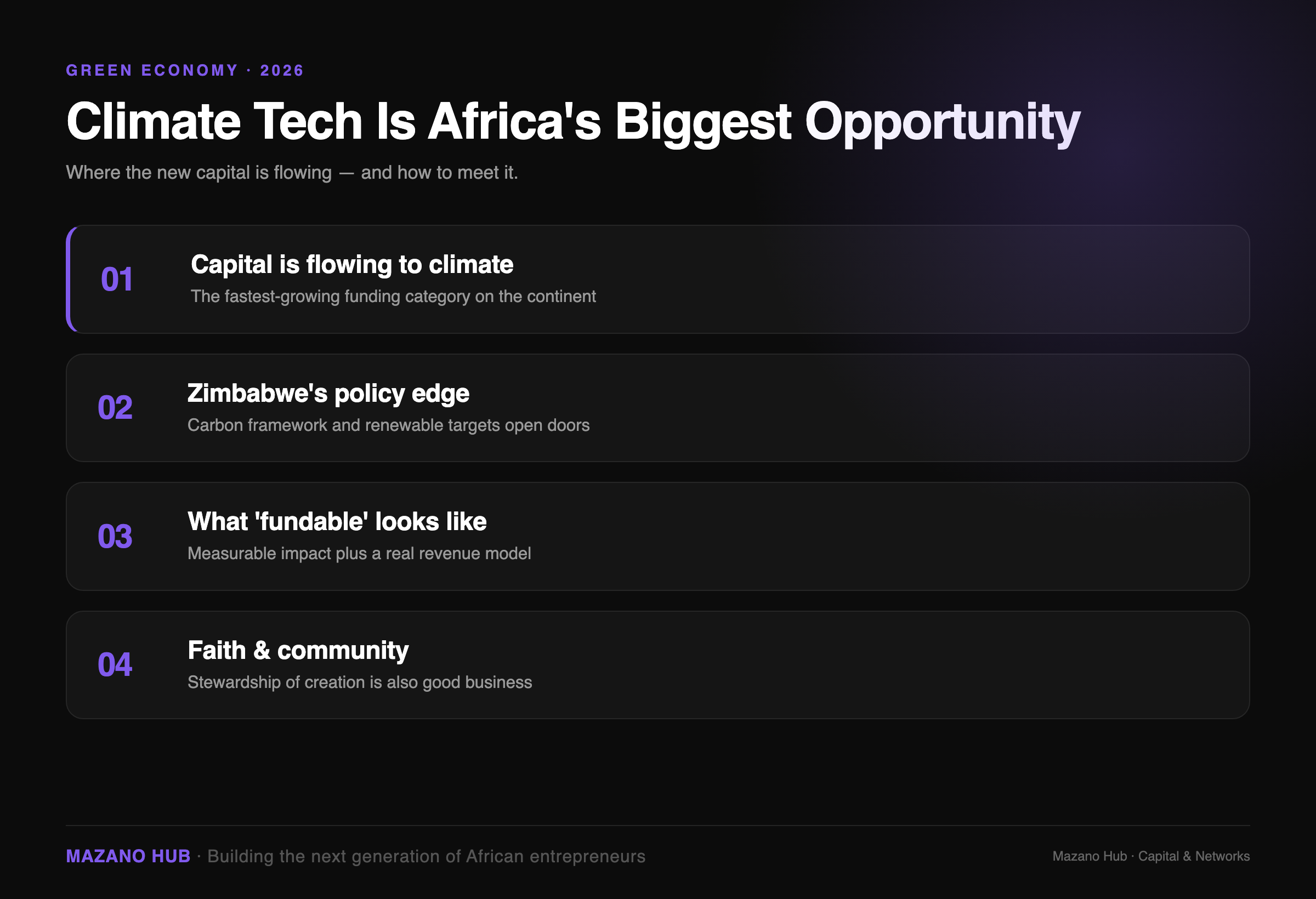
Something significant shifted in Africa's investment landscape in 2026. For the first time, clean energy startups attracted more capital than fintech. The investors who spent a decade chasing mobile money and payments are now writing checks to solar entrepreneurs, sustainable agriculture ventures, and climate-resilient logistics businesses. And Zimbabwe — with its government incentives, growing diaspora investor base, and community-rooted entrepreneurial culture — is sitting directly in the path of that capital.
This is not abstract news. It is a specific, time-bound opportunity for Zimbabwean founders who understand how to position their businesses for the funding that is actually moving. This week, we break down why the green economy is Africa's most important business story right now, and what it means for founders preparing to launch or scale.
|
|
|
|
Section 1
Why Climate Tech Is Now Africa's Biggest Funding Opportunity
In 2022, fintech commanded nearly 60% of all venture capital deployed across Africa. By 2025, that share had dropped to around 25%. The money did not disappear — it rotated. Climate tech companies raised a record $1.18 billion in 2025 alone, and early 2026 data shows that trend accelerating. Across the continent, solar deployment businesses, agritech ventures solving water and soil challenges, and sustainable logistics startups are closing rounds that fintech entrepreneurs are struggling to match.
Why the shift? Several forces converged. Global climate commitments pushed institutional investors to deploy capital into African green infrastructure as part of net-zero mandates. Development finance institutions — the World Bank Group, AfDB, the EU's investment arms — dramatically increased grant and concessional loan facilities for clean energy. And on the demand side, Africa's persistent energy deficit means that a founder who solves local power or water problems is solving a real, commercially viable problem from day one.
The emerging opportunity in 2026 is specifically at the intersection of climate and financial infrastructure: businesses that finance, distribute, or service solar systems, clean cooking solutions, electric logistics, and sustainable agricultural supply chains. These ventures can access not just equity, but blended finance structures — combining grants, impact loans, and revenue-based financing — in ways that pure-play technology startups cannot. For a founder with $5,000 in startup capital and a real community problem to solve, this is the most accessible funding ladder that has ever existed in Africa.
The RAISEAfrica 2026 Accelerator Programme, currently accepting applications, is a direct signal: international capital is looking for African green founders right now. The question is whether Zimbabwean entrepreneurs are positioned to apply — and more importantly, to win.
|
|
|
|
Section 2
Zimbabwe's Green Policy Edge
Zimbabwe has quietly built one of Southern Africa's more supportive policy environments for green entrepreneurs. The government offers tax exemptions and duty-free importation for renewable energy equipment, reducing startup costs for solar businesses significantly. Special Economic Zones have been structured to reward manufacturers and distributors of clean energy technology, with incentives that can transform the financial model of a new venture from break-even to profitable within its first operating year.
In 2025, Zimbabwe's Treasury took a further step by launching the National Venture Capital Company of Zimbabwe, specifically targeting support for startups in renewable energy, sustainable manufacturing, and agricultural innovation. This is not a small grant program — it is a national instrument designed to catalyze early-stage capital into sectors the government has identified as growth priorities. For founders who know how to engage public capital, this creates a real co-investment pathway.
The Joint SDG Renewable Energy Fund programme, operating in Zimbabwe with international backing, is focused on removing financing barriers for energy projects with measurable social impact. Rural solar distribution, community water access, and clean cooking solutions that serve low-income households are exactly the type of ventures this fund was designed to support. Combined with EU-funded green skills training programs currently running in-country, there is an ecosystem of support available to founders — if they know it exists and know how to access it.
The challenge is not the absence of policy support. The challenge is that most early-stage founders in Zimbabwe are not connected to these mechanisms. They do not speak the language of impact reporting, SDG alignment, or blended finance. That knowledge gap is more significant than the capital gap — because for the founder who closes it, the capital becomes accessible almost immediately.
|
|
|
|
Section 3
What Fundable Looks Like for a Zimbabwean Green Founder
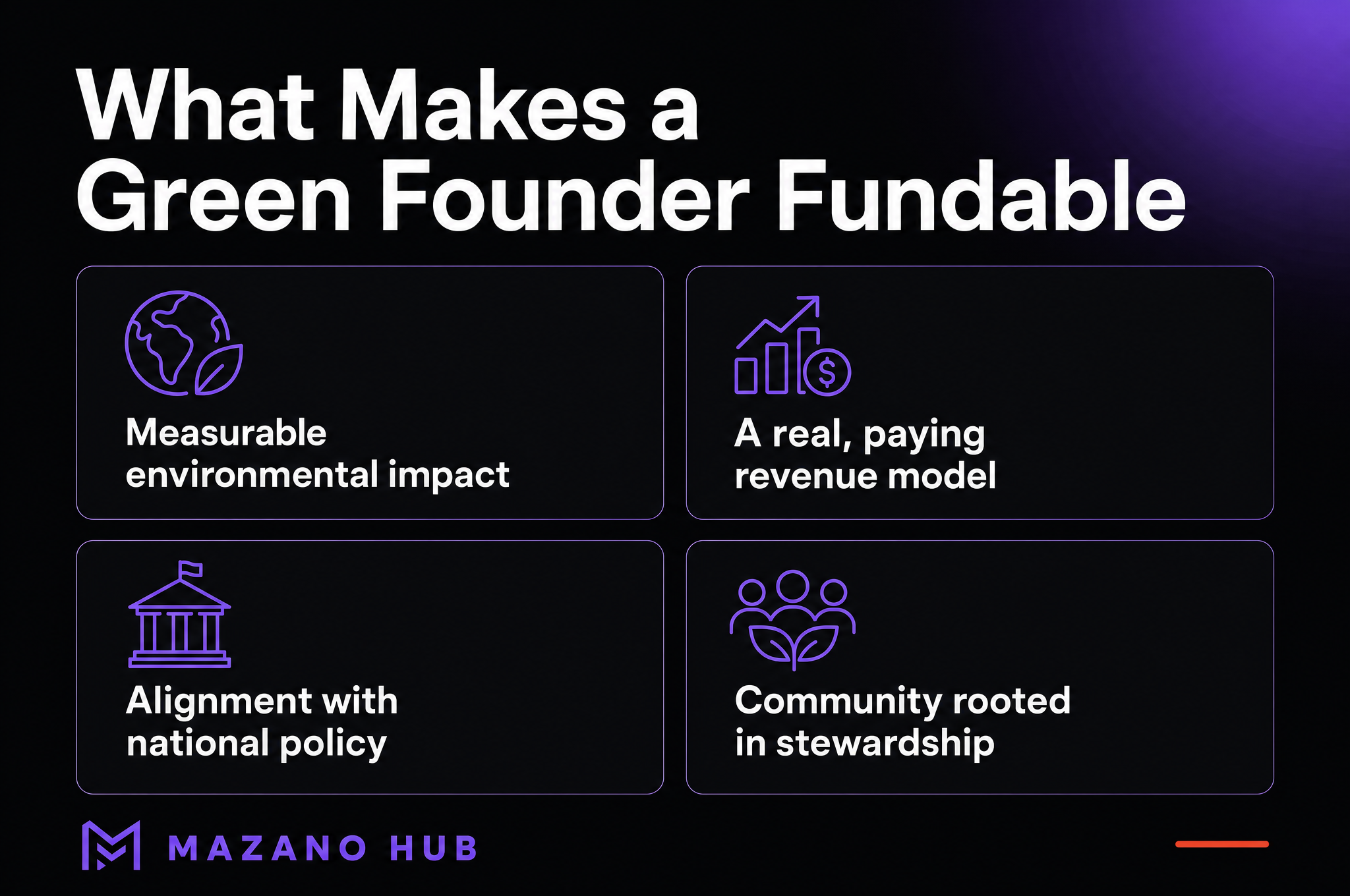
Investors funding African climate tech in 2026 are not looking for the next unicorn. They are looking for ventures with three specific characteristics: a measurable environmental or social problem being solved, a business model with a clear path to financial self-sufficiency, and a founder who understands both the local context and the language of impact measurement. Zimbabwean founders, many of whom have built businesses in spite of infrastructure failure rather than because of infrastructure support, have a credibility advantage on the first point that founders in Lagos or Nairobi simply do not have.
The deals getting done in Zimbabwe's early green economy include: solar distribution businesses serving rural and peri-urban households, sustainable agricultural input supply chains (fertilizer alternatives, seed access, storage solutions), waste-to-value ventures in urban centers, and eco-tourism infrastructure being rebuilt after years of underinvestment. What they share is that the founder built the business from genuine community need, not from trend-chasing. Impact investors find that authenticity difficult to manufacture — and they recognize it immediately.
What separates the funded from the unfunded is not usually the strength of the idea. It is the quality of the business documentation, the ability to articulate impact in the language funders use (emissions avoided, households served, jobs created), and the existence of a credible growth plan. A founder who can present: here is my problem, here is my customer, here is what we have done with $3,000, here is what we will do with $50,000 — that founder is fundable. The gap between a Zimbabwean founder with a good idea and that presentation is a six-month structured learning process. That is exactly what an incubator should deliver.
The most practical steps a green founder can take right now: get your business registered, document your first customers, write down your impact metrics even if they are rough, and apply to every open accelerator program — including RAISEAfrica 2026, the UNDP Climate Catalysts Programme, and Mazano Cohort 1. Being in the pipeline matters. Funders meet founders at programs. The relationship that produces a check in 2027 often starts at an accelerator demo day in 2026.
 What Makes a Green Founder Fundable |
|
|
|
|
Section 4
How Faith and Community Drive Sustainable Business
Sustainable business and faith-driven entrepreneurship are not separate categories. They draw from the same root: a conviction that business should serve people, that profit is not the only measure of success, and that stewardship of resources — natural, financial, human — is a moral responsibility. Zimbabwe's church networks, communal land traditions, and deep sense of ubuntu (the understanding that one's wellbeing is inseparable from the community's wellbeing) are not just cultural assets. They are operational advantages for green entrepreneurs.
Impact investors explicitly seek founders who are rooted in the communities they serve. A solar entrepreneur who distributes through church networks has distribution infrastructure that a startup in a London accelerator cannot replicate. A waste collection venture built on neighborhood solidarity has customer retention that money cannot buy. These are structural competitive advantages, and they come directly from the kind of community accountability that faith-based founders carry naturally.
The long-term nature of green business — building infrastructure that will last twenty years, changing community behavior around energy and agriculture, stewarding land and water resources — requires a founder with a longer time horizon than the typical growth-hack startup mentality allows. Faith-driven founders tend to think generationally. That is not a disadvantage in climate enterprise. It is exactly the posture that long-term impact capital wants to back.
This is why Mazano Hub exists at the intersection of faith and entrepreneurship. Not as a religious program, but as a recognition that the values infrastructure — integrity, community accountability, long-term stewardship, servant leadership — is the same infrastructure that builds enduring businesses. In a green economy that rewards exactly those qualities, Mazano's founders are entering the market with an advantage most accelerators cannot teach.
|
|
|
|
From Mazano Hub
Cohort 1 Is Being Built for This Moment
Mazano Cohort 1 is shaping its curriculum around the funding landscape that actually exists in 2026 — not the one from five years ago. We are designing a dedicated module on green business framing and impact language, because knowing how to communicate your business in the terms funders use is not selling out. It is the difference between a good idea that stalls and a fundable venture that moves.
We are specifically looking for founders working in agriculture, energy, sustainable manufacturing, and community services — the sectors where Zimbabwe's policy environment and the global capital shift converge. If you are building in one of these spaces, or if you are an early-stage founder who wants to understand how to enter them, Mazano Cohort 1 launching mid-2026 is built for you.
The window is open. The capital is moving. The question is which Zimbabwean founders will be ready when it arrives.
|
|
Ready to build?
Apply to Mazano Cohort 1
Launching mid-2026 for early-stage African entrepreneurs. Faith-driven. Community-rooted. Investor-ready by design.
Apply at mazano.org
|
|
Mazano Hub — Empowering African Entrepreneurs Through Faith, Community & Capital
mazano.org
You received this because you subscribed to Mazano Hub updates.
|
Unsubscribe
|
|
|