|
Mazano Hub
How Zimbabwe Founders Build
|
||
Every week, talented Zimbabwean entrepreneurs approach investors, grant committees, and incubator programs with ideas that deserve backing. And every week, many of them walk away empty-handed — not because the idea was wrong, but because the business wasn't investor-ready.
Investor readiness isn't a gatekeeping trick. It's a communication discipline. It means you can answer the questions capital asks before capital asks them: What problem are you solving? Who is your customer? What have you already built? What does the money do? Where does it go? This edition of Mazano Hub breaks down what investor readiness actually means in the Zimbabwean context — and how Mazano's Cohort 1 program is designed to get founders there. |
||
|
|
||
1. Why Good Ideas Don't Get FundedThe most common reason a Zimbabwean founder gets turned down for funding isn't a bad idea. It's a documentation gap. The idea is there. The passion is there. The customer is real. But the pitch deck doesn't exist, the financial model is built on napkin math, and the founder can't explain unit economics in two sentences. This is not a Zimbabwean problem alone — it's a structural problem across early-stage African entrepreneurship. Most founders build in isolation, without access to the vocabulary or frameworks that investors use. They learn the business through doing it, not through presenting it. When it's time to raise, they're fluent in execution but struggling with communication. The mismatch is costly. Impact investors are sitting on capital that needs to be deployed. Local angel networks want deal flow. International donors are searching for credible partners. But the chasm between a founder's vision and an investor's expectations remains wide — and most programs don't close it. The good news: investor readiness is teachable. It isn't about having a perfect business. It's about being able to communicate the business clearly, back claims with evidence, and show that you understand the risks as well as the opportunities. |
||
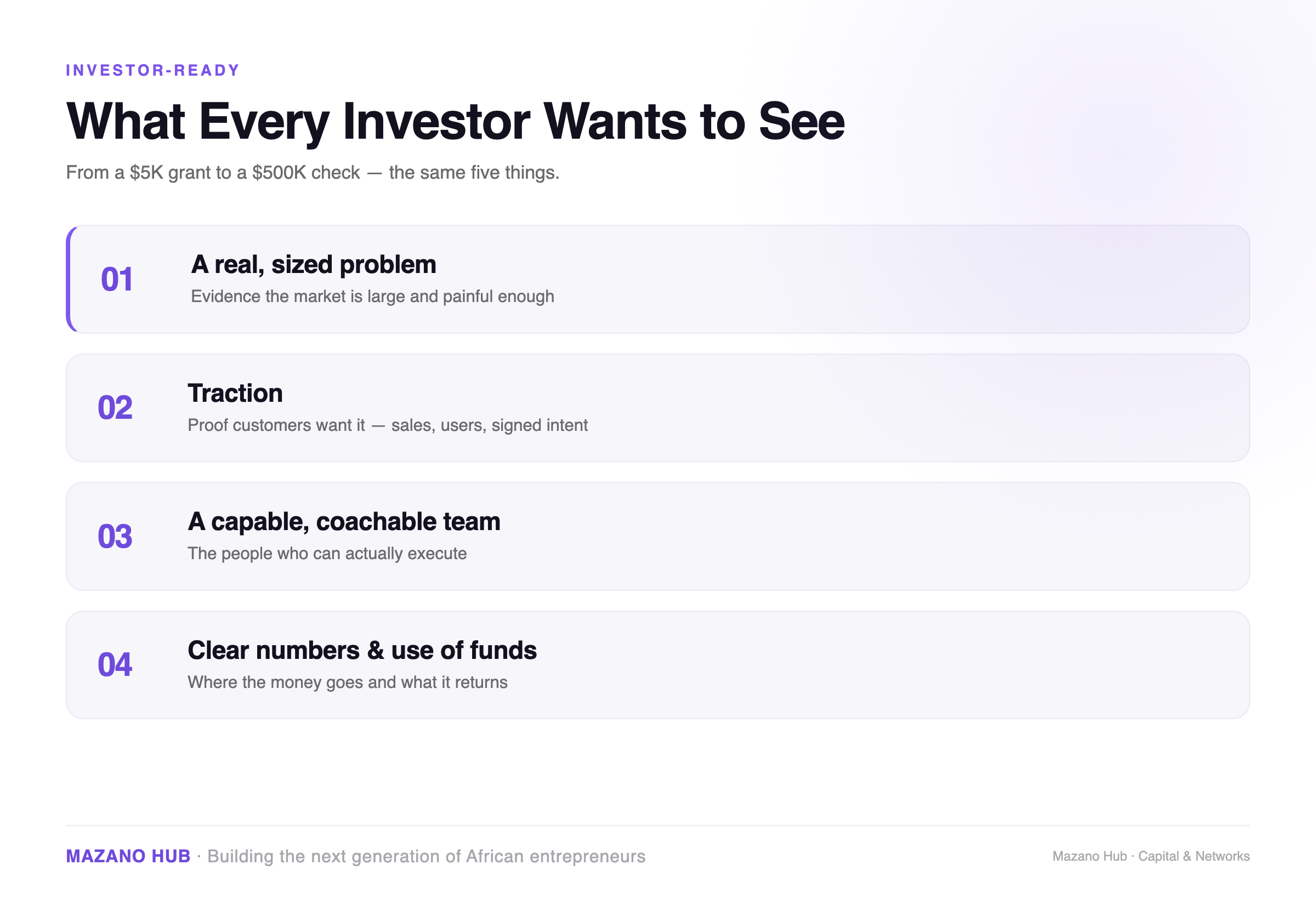
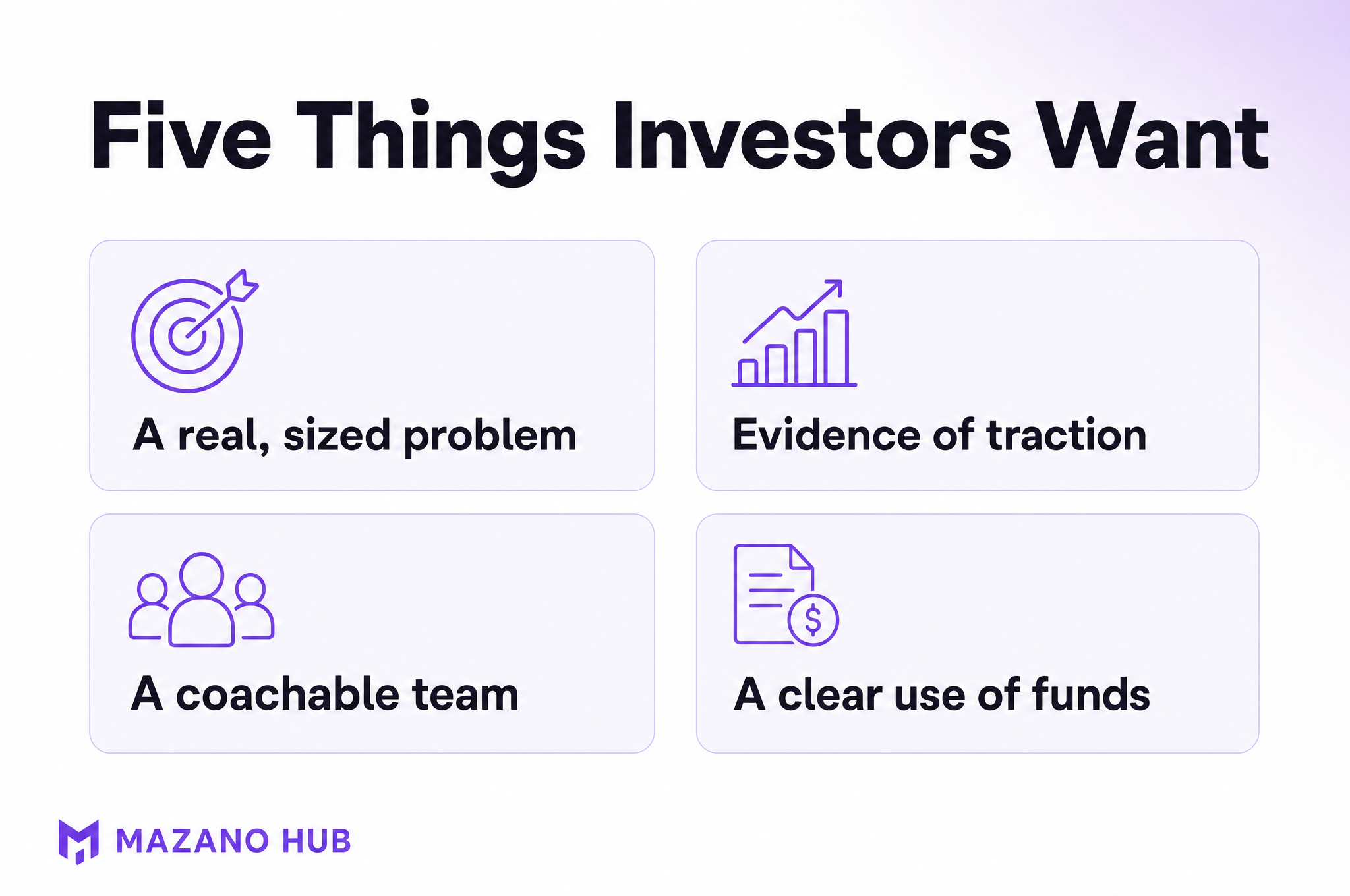
2. The Five Things Every Investor Wants to SeeWhether you're approaching an impact fund, a church-based angel group, or a diaspora investor in the UK or US, the questions are remarkably consistent. Investors at every level — from a $5,000 grant to a $500,000 equity check — want to know five things. Traction. What have you already built? Who is already using it? Traction is the most powerful signal in any pitch. It doesn't have to be large — it has to be real. Even ten paying customers beat a thousand optimistic projections. Financials. What does your revenue look like? What are your costs? What does the money do? Founders don't need an MBA to build a basic financial model — they need to know their numbers and explain what investment buys. Market. How large is the problem you're solving? Who specifically is your customer? Investors want a market that's real, reachable, and growing — not a generic "Africa has 1.4 billion people" claim. Team. Why are you the person to build this? Who is with you? A founding team with complementary skills and relevant experience dramatically increases investor confidence, especially at the early stage. Story. Why does this matter? What changes in people's lives if you succeed? Impact investors in particular respond to a clear narrative about what the world looks like when the problem is solved. The story connects the spreadsheet to the mission. |
||
3. Zimbabwe's Unique Investor LandscapeZimbabwe's investment environment has shifted significantly in the past three years. The dollarization of the economy has reduced foreign exchange risk for local deals. The country's startup ecosystem — while still nascent — is producing founders who have built businesses through multiple economic crises. That resilience is itself a signal to investors. Three capital sources are most accessible for early-stage Zimbabwean founders right now. The first is the diaspora. Zimbabweans in the UK, US, Australia, and South Africa control significant capital and are increasingly willing to back founders back home — particularly when the pitch is credible and the relationship is warm. Church networks and diaspora professional associations are natural entry points. The second is impact funds. A growing number of African-focused impact investors — funds based in Kenya, South Africa, and internationally — are actively looking for Zimbabwe deal flow. They want founders with a clear social mission, demonstrated traction, and a capable team. Grant-to-equity pipelines are common here.
The third is faith-based philanthropic capital. Churches and Christian foundations both in Zimbabwe and internationally are allocating more resources toward entrepreneurship as a development strategy. This capital often comes with lower return expectations — but higher relationship expectations. Founders who can speak the language of mission alongside the language of business have a significant advantage. |
||
4. How Cohort 1 Prepares Founders for InvestmentMazano's Cohort 1 program launches mid-2026 in Harare, and investor readiness sits at the center of the curriculum — not as a bonus module, but as the through-line of every session. Over twelve weeks, Cohort 1 founders work through a structured progression: from clarifying their business model and identifying their target customer, to building their first financial model, drafting a one-page pitch, and presenting in front of a live panel of investors and mentors. Every session is built around a deliverable, not a lecture. The Mazano approach combines two elements that are rarely found together in African incubators: rigorous business skills training and faith-grounded community. Founders learn to model their financials and also to articulate why their work is a calling. That combination produces founders who are credible in a pitch meeting and resilient in adversity — exactly the profile that patient capital is looking for. Cohort 1 is finalizing selections now. Applications are open at mazano.org. If you know a Zimbabwean founder who is serious about building a sustainable business and is ready for structured support, this is the moment to connect them. |
||
The Mazano AngleMazano exists because the problem is real and the solution is within reach. Zimbabwe has founders. Africa has capital. The gap is preparation and connection. That's what we close. Cohort 1 is our first opportunity to prove that a faith-grounded, skills-first incubator can produce investor-ready founders from Zimbabwe and into the regional startup ecosystem. We're building the program we wish had existed when these founders first started. We'd be grateful for your support — whether that's prayer, partnership, a referral, or a donation that funds a founder's cohort fee. |
||
Know a founder who's ready to build?Cohort 1 applications are open. Share this with a Zimbabwean founder who is serious about growth. Apply at Mazano.org |
||
|
Mazano | Faith-Driven Entrepreneurship Incubator | Harare, Zimbabwe mazano.org | [email protected] You are receiving this because you subscribed to Mazano Hub. | Unsubscribe |