Zimbabwe's Women Entrepreneurs Are Building What's Next
How women-led startups are quietly reshaping Zimbabwe's economy — and why Mazano's Cohort 1 is designed to accelerate them.
 |
Walk through any market in Harare on a Tuesday morning and you'll see them: women selling produce, running mobile money stalls, managing informal lending circles, and building businesses with almost no institutional support. Zimbabwe's women entrepreneurs are not a quiet statistic. They are the backbone of a resilient, community-embedded economy — one that has survived hyperinflation, sanctions, and political instability that would have collapsed most formal markets.
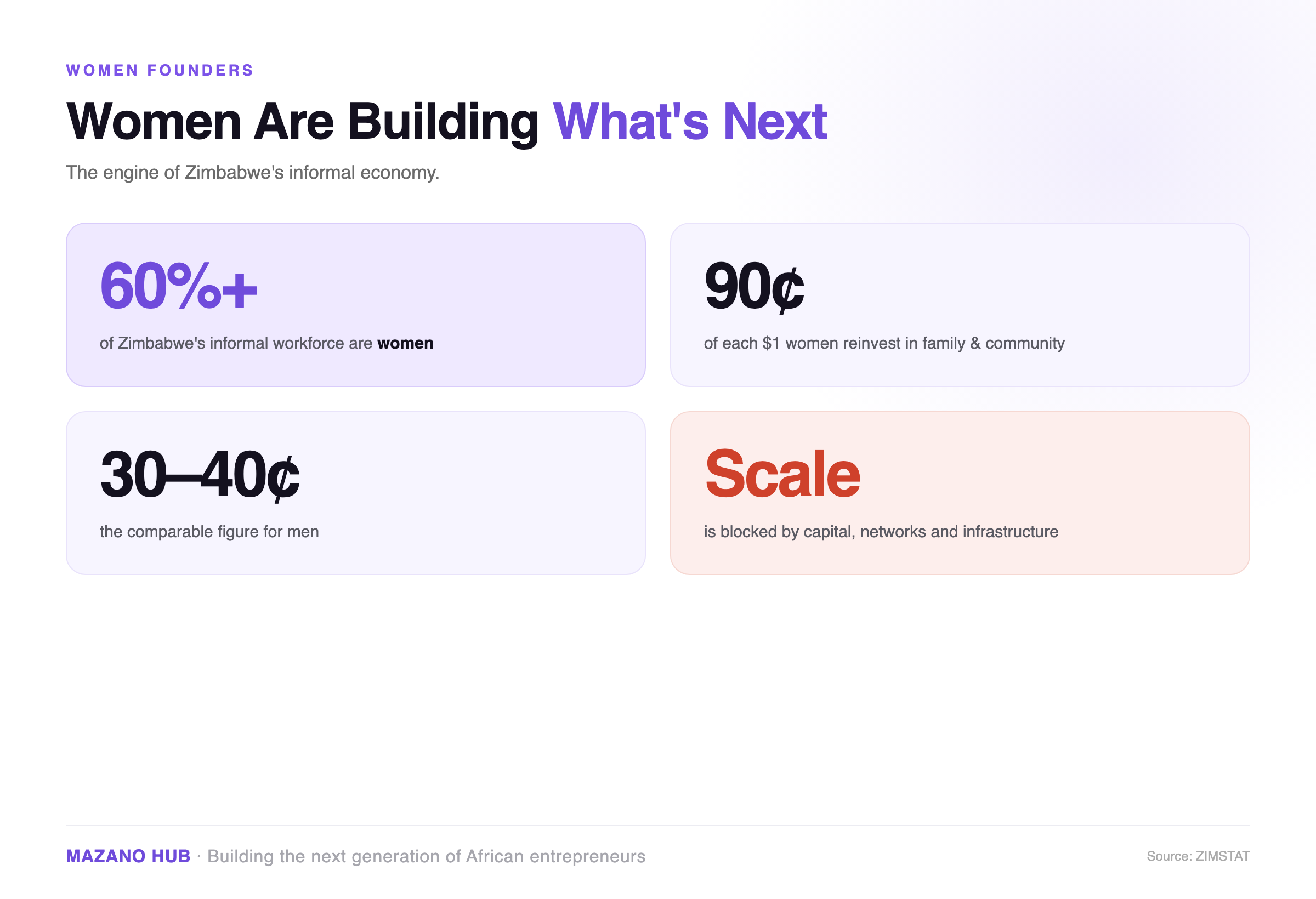 Women reinvest far more of what they earn — and drive the informal economy. |
What's missing is not ambition. What's missing is infrastructure, access, and belief from those with capital. That gap is exactly what Mazano Hub exists to close. With Cohort 1 launching in Q2 2026, we are building a program that doesn't just welcome women-led ventures — it is structured to address the specific barriers that have held them back. This newsletter is for every woman who has a business idea and has been told to wait, and for every donor or partner who wants to fund change that actually compounds.
1. The Numbers Don't Lie: Women Are Driving Zimbabwe's Informal Economy
Women account for more than 60% of Zimbabwe's informal sector workforce, according to the Zimbabwe National Statistics Agency. They run agricultural supply chains that feed urban households, operate savings cooperatives — locally called mukando or cheetah clubs — that substitute for the banking access they lack, and make up the majority of microenterprise owners in high-density suburbs like Mbare, Budiriro, and Highfield.
Across sub-Saharan Africa, the picture is similar. The World Bank estimates that women entrepreneurs represent one of the highest-potential but lowest-served segments in emerging markets. African women reinvest up to 90 cents of every earned dollar back into their families and communities — compared to 30–40 cents for men. That's not charity. That's leverage. Every dollar that reaches a woman-led business in Zimbabwe doesn't just build a business; it builds a neighborhood.
The opportunity is enormous. The underinvestment is even larger. And that mismatch — between potential and access — is where the real story lives. Zimbabwe's women entrepreneurs are not waiting for permission to lead. They are already leading. The question is whether the institutions that claim to support entrepreneurship will catch up.
2. What's Holding Them Back: The Real Barriers to Scale
The barriers are structural, not motivational. Women entrepreneurs in Zimbabwe consistently face a set of compounding obstacles that don't affect their male counterparts in the same way.
Credit access: Zimbabwe's formal banking sector historically required collateral — land titles, vehicle ownership, building deeds — for business loans. Women are less likely to hold these assets in their own name due to inheritance laws and cultural norms. The result: even creditworthy women are locked out of formal financing and reliant on high-interest informal lenders or savings clubs with limited capital ceilings.
Mentorship gaps: Business mentorship networks in Zimbabwe skew heavily male. The informal systems that accelerate men — professional associations, church deacon boards, alumni networks — are frequently closed or uninviting to women founders. Without access to experienced mentors who have solved the problems you're facing, early-stage businesses stall at the point where growth capital and strategic advice are most needed.
Time poverty: Women entrepreneurs frequently carry disproportionate caregiving responsibilities. A woman running a business while managing a household has fewer hours to attend training sessions, pitch to investors, or iterate on her product. Programs that don't account for this reality — through flexible schedules, childcare provisions, or remote participation options — will always underperform with this segment.
These are solvable problems. But solving them requires programs designed with these realities in mind from day one — not retrofitted as an afterthought when participation numbers disappoint.
3. Faith, Community, and the Missing Support Infrastructure
Zimbabwe is one of the most church-going nations on earth. On any given Sunday, a significant portion of the population is gathered in congregations that span denominations, languages, and economic classes. These churches are not just spiritual homes — they are community infrastructure: childcare networks, social lending circles, referral economies, and trust systems built over decades.
For women entrepreneurs, the church is often the most accessible point of community support. A pastor who believes in your business idea and vouches for your character opens more doors than a bank loan application. A women's fellowship that meets weekly creates the accountability structure that most incubators pay thousands of dollars to simulate. These trust networks are real assets — they just need to be connected to the right business development tools.
The problem is that faith communities often lack the business knowledge to convert this social capital into economic capital. Good intentions and prayer — valuable as they are — don't replace a pitch deck, a cash flow model, or a mentor who has navigated the same manufacturing challenge you're facing.
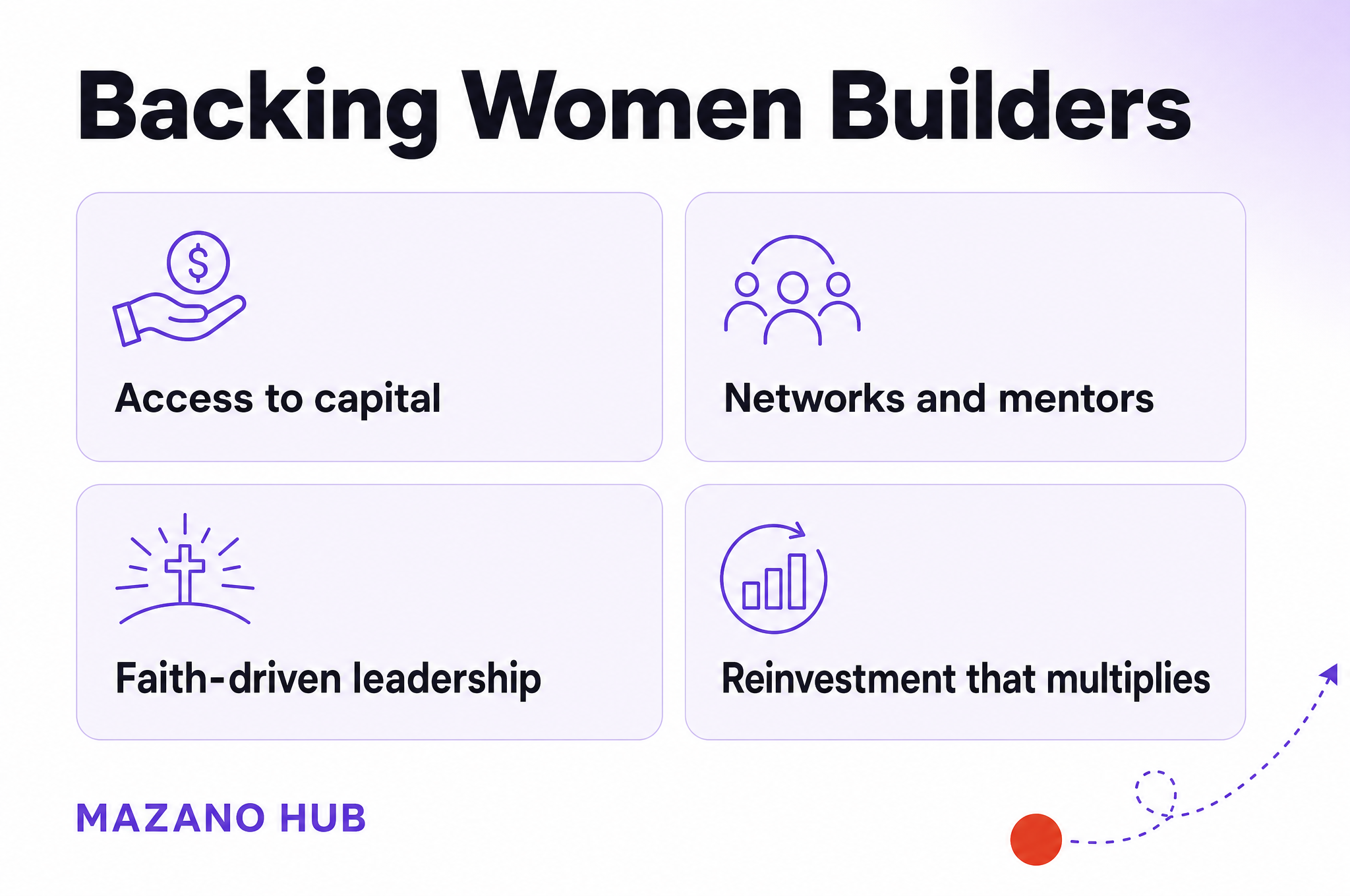 Backing Women Builders |
Mazano was built to be the bridge between these worlds. Our faith-driven curriculum doesn't extract entrepreneurs from their faith communities — it equips those communities to become engines of economic transformation. Women entrepreneurs who complete a Mazano program carry skills back into their churches, their savings clubs, and their neighborhoods. The ripple effect is the point.
4. Mazano Cohort 1: Built for Builders Like You
Mazano's Cohort 1 launches Q2 2026 — and it is designed from the ground up to serve the entrepreneur who has been overlooked by conventional programs. Here is what that means in practice.
Our Harare facility at 716 Maple Street, Sunway City offers 2,100 square meters of co-working space, conference rooms, guest bedrooms, and flex space — all powered by off-grid solar and connected via Starlink satellite internet. No load shedding. No data caps. The infrastructure constraints that have blocked so many Zimbabwean businesses from operating at full capacity are solved on day one.
The Next Step Bootcamp runs 10 weeks, combining business fundamentals with the faith-driven leadership principles that make Mazano distinct. Participants receive direct mentorship from experienced entrepreneurs, access to our investor and church partner network, and the opportunity to pitch at Demo Day — a live investor showcase that creates direct capital access without gatekeepers.
For selected participants, Mazano offers equity-free seed grants. There is no equity taken in your business. The investment Mazano makes is in your capacity, your community, and your future — and it stays there. Applications are open now. If you are a woman entrepreneur in Zimbabwe — or you know one — the time to move is today.
The Mazano Angle
Cohort 1 is not a general-purpose business program. It is a targeted intervention built for early-stage Zimbabwean founders who have been building without the right support. Women entrepreneurs are a priority segment because the evidence is clear: when women build sustainable businesses, communities grow. We are actively seeking applications from women-led ventures across manufacturing, technology, agriculture, and services. The deadline is approaching. Apply now at mazano.org.
Applications Open — Q2 2026
Apply to Mazano Cohort 1 —
the program built for builders like you.
Are you a church, foundation, or diaspora professional who wants to support women entrepreneurs in Zimbabwe?